An ocean of misinformation

Summary

I wrote this in preparation for participation in the Seafood Matters podcast where I was interviewed by Jim Cowie.

The fishing industry has been subject to a barrage of simplistic propaganda over the last few years.  The non-scientific narrative funded by opinion holders has the potential to impact on governmental policy and stakeholders.  The narrow-minded obsession with MPAs as “the solution” to ecological management has the potential to do more harm than good.  Environmental NGOs and media stars with an interest in supporting sustainability need to talk to stakeholders to get balanced views.

Article

I have been troubled by the recent concerted and ideological campaign against the fishing industry in the UK by NGOs, often well funded by overseas foundations that were often set up by oily oligarchs (MarInnLeg, 2025).  In the UK what we are seeing is a fundamental industry being impacted by the cold dead hands of American philanthropists.  First Seaspiracy and then more recently the film Ocean have served as adverts for this ideological, anti-science and anti-fishing campaign.  They have been enough to scare politicians into considering blanket bans on fishing that will potentially damage an industry and vulnerable coastal communities.  The call for several months now has been to ban all trawling in Marine Protected Areas (MPAs).  This is despite the fact that MPAs have been through a consultative process involving NGOs, government and the fishing industry, are designated to protect specific features and the regulations for each one are appropriate to eliminate impact on those features.  Where the MPA is designated to protect something like slow-growing maerl beds (which serve as nursery grounds for scallops), banning bottom trawling makes sense.  Where the designation is to protect cetaceans, banning bottom trawling, that has pretty much zero interaction with cetaceans, makes absolutely no sense at all.  It is purely a vindictive attempt to target the fishing industry.

The attempts by well-funded organisations to exclude commoners from the sea that they have used to gather food for hundreds of years resembles the clearances.  The power imbalance is the same now at sea as it was historically on land.  In the past the commoner on land had no lawyers or pieces of paper to help them retain their rights.  Until recently, no one organisation (aside from the crown) could own areas of the sea inside the UK EEZ.  A fisherman’s string of pots had the same legal right to occupy an area as a jack-up barge or a windfarm.  Now windfarms take up increasing swathes of the sea and represent de facto ownership of areas of seabed.  The historic concept of freedom of the seas appears to have vanished.  We’ve seen the development of spatial management that controls when, where and what fishermen can catch, including management supported by fishermen such as real time closures (Needle and Catarino, 2011; Woods et al., 2018).  This is an effective management measure which means that when a fisherman catches too many fish of the wrong sort or size s/he reports it, and an area is closed for a while.  Now we are seeing the development of permanent marine enclosures, the deliberate exclusion of traditional users of the commons from their resources – not backed by science but by fanatical ideology.  This is a holy war by the lobbying industry against the fishing industry.  I have seen someone from Oceana present a slide at a conference that suggested respected fisheries scientists and industry representatives are “the enemy” (MBA conference, Hull University, 2025).

The law locks up the man or woman,

Who steals the goose from the common,

But leaves the greater villain loose,

Who steals the common from the goose

(17th Century song lyric)

MPAs are attractive as a silver bullet to people who are ignorant, sometimes wilfully, of the complexity of marine ecosystems.  Fish numbers increase inside areas where fishing is prevented but MPAs do nothing to reduce fishing effort (Hilborn, 2018).  In fact they increase fishing effort.  Fishing patterns are not random and have often been established over many, many years.  Fishermen target areas where there are fish.  These are often the same areas that are targeted for “protection”.  When they can no longer fish in areas where fish are abundant they have to target areas where abundance is less.  This means that they have to fish harder and cover more area and use more fuel or gear to catch fewer fish.  For example, recent work has demonstrated that spatial restrictions have doubled the carbon footprint of Norway’s mackerel fishing fleet (Scherrer et al., 2024).These naive views of the marine environment are often amplified by the voices of celebrities who have little knowledge of the complexities of marine ecology and fisheries science but, are instinctively attracted to simplistic and what appear to be blindingly obvious solutions.

For every complex problem there is a solution that is obvious, straightforward and completely wrong (Unknown)

Where large scale MPAs have been designated they have often failed to achieve any change in commercial fish numbers (Hampton et al., 2023).  This can be because the design of protected areas is influenced as much by politics as ecology (Caveen et al., 2014; Dunne et al., 2014; Caveen et al, 2015).  In addition politicians facing a barrage of slick marketing from NGOs are more likely to seek a rapid “one step” solution than engage with the complex and nuanced processes that ensure legitimate, just and sustainable transitions.

What is particularly annoying is the fact that despite the desire of some to draw pretty but often pointless boxes on charts there are actually many and varied effective methods to manage fisheries – to manage how much they catch and how they interact with the environment.  Fishermen want to save money so the trawls that they have developed in recent years in partnership with governmental and non-governmental scientists are much lighter than they were years ago and take much less bycatch – certainly nothing like the 80% figure that has been bandied about recently.  These lighter trawls skim over the surface of the seabed and require much less fuel.  Static gear nets such as drift nets once used to occasionally capture cetaceans and seals.  Legitimate fishermen don’t want to catch these animals so they started attaching pingers to the nets to scare them away.  With the global growth in the number of lobster/crab pots, possibly related to the demise of trawling, there has been a rise in some areas in the occasional cetacean entangled in the buoy lines.  Fishermen have responded to this phenomenon by working with scientists and developing ropeless fishing gear that only deploys the buoy line when the fisherman comes to collect it (Myers et al., 2019).

The ongoing dependence of the conservation industry on, or misuse of, poor science to buttress their desire to expunge the fishing industry is not new.  Many of the academic papers that have made  international headlines that suggest the fishing industry is destroying the ocean have later turned out to be untrue.  These include the assertion that all fish will be gone from the oceans by 2048 and we will have to eat jellyfish, the suggestion that trawling releases as much CO2 into the atmosphere as the aviation industry, that there are only 100 cod left in the north sea, that all large fish species have been pushed towards extinction or that fishing covers 55% of the ocean.  All have been later found to be based on really misleading analysis and are often published by scientists who have received funding from foundations that have an anti fishing agenda (Cochrane et al., 2024).  I am not aware of any core fisheries science papers that have set out to mislead the public or ended up on the Retractionwatch.com database.

Many in the conservation industry want to see little chocolate box boats skippered by Captain Birdseye types in quaint towns as the only survivors in the fishing industry.  These boats are the shop window for the fishing industry, tourists in coastal towns always gravitate to the harbour to enjoy the spectacle of fishing boats bustling around the harbour or landing their catch.  However they do not represent all of the fishing profession and are in some ways the most problematic to manage. From a carbon and management perspective the large so-called industrial fisheries that efficiently target huge shoals of pelagic fish such as mackerel are much better than small scale fishers. The fish that industrial trawlers (the combine harvesters of the sea) catch is some of the most carbon friendly foodstuff we harvest (Parker and Tyedmers, 2014).  Where small scale fishers win is in the fact that one fisherman at sea supports 7-14 people ashore, something that is completely critical for economically challenged coastal communities.

The attractiveness of fishing villages, such an important part of our culture, is such that coastal towns are being hollowed out as the price of houses in them goes far beyond what a small scale fisherman can afford (Thompson et al., 2016).  The well-heeled folk who can afford to retire to quaint coastal villages or own 2nd homes, that remain empty for months at a time, have a different set of values than the industrious folk who built these communities.  The new inhabitants value the aesthetics of the environment in which they live but have no deep economic ties to it.  They see their values as being superior to those of the “natives” who once populated these places year round and depended on what they could get from the sea to make a living.  Many areas dominated by fishing cultures are now go-to destinations for the cruise industry.  This industry burns unbelievable amounts of carbon and is turning the high streets in their target communities into Hollywood-esque facades of what they once were.  Because the cruise industry relies on large-scale corporate supply chains they don’t even buy their supplies from the communities they visit.  Their clients are shepherded ashore in packs to panic buy tat (probably manufactured in China) from touristic shops.

The holier than thou, or even racist, undertones of the conservation movement have deep roots.  The establishment of the national parks in the USA was driven by white men who viewed the indigenous populations who lived there as subhuman, filth on the face of the beautiful landscape they wanted to remain pristine, untroubled by human activity.  Our modern views of wilderness and what developing nations should look like from a global north perspective are driven by a skewed view of Africa seen by the white men who “discovered” it (Adams and McShane, 1997).  They encountered a land that had recently been ravaged by disease and war, where humanity had receded for a while.  What the white explorers saw was a ravaged landscape.  Following discovery of the continent its people were enslaved and viewed as property.  Peoples who provided slaves to work on plantations owned by northern Europeans could not possibly have the wherewithal to manage their own environments.  They needed a paternal empire to step in and give them civilization. 

When asked what he thought of Western civilization, Mahatma Gandhi replied, “I think it would be a good idea.” 

What we have seen historically on African, South American and Asian continents was driven by the same mindset that is driving current marine conservation.  Apparently fishing communities cannot possibly look after their own resources, its like letting the fox into the hen house. They apparently need people from outwith their communities to tell them how to manage the resources they have been harvesting for centuries.  There is little difference between the great white saviour in Africa or the American upper classes of the early 20th century and the entitled opinion-holders who currently seek to exclude stakeholders, who have a real and daily connection with the environment, from making a living.  Their skewed view of how the world should be is driving indigenous and semi-indigenous peoples from their traditional terrestrial and marine resources to the periphery of a modern society.  In the global south, commoners are stripped from their complex and intrinsically linked ecological and social networks to end up in poverty or serving white folks in seasonal tourist jobs or the service sector (Dowie, 2011).  In South Africa some MPAs have been unilaterally declared and what were thriving fishing villages have nice holiday homes for cape towners on the seaward side of the road and shanty towns on the landward side, full of people who used to be proud fishermen.  We see the same patterns in the global north, quaint fishing towns such as Anstruther, Staithes and Crinan have lost their reason to exist beyond being escapes from reality for wealthy city folk.

By allowing an unscientific narrative to dominate the conservation agenda in the Global North we encourage “conservation leakage”, the displacement of fishing effort to parts of the world where fisheries management is less effective.  The EU currently imports 70% of the fish it consumes (EUMOFA, 2023).  This is unsustainable and threatens the livelihoods of people in the global south who depend on local coastal, often low trophic level small pelagic species.  With climate change it is predicted that while there will be 30-70% increases in potential catch in high latitudes, there will be decreases in the tropics by 2055 (Cheung et al., 2010).  Thus socioeconomically vulnerable people will have to compete with the financial might of the global north to access their own fish that are diminishing because of the carbon heavy historical activities of the rich.

Celebrities and NGOs talk about the importance of co-management.  What they actually mean is taking the rights to make a living off commoners and giving them to corporations and populist environmentalists (Hunt and Hilborn, 2025).  The power to manage fisheries needs to be given back to the people who have an economic and social stake in their health.  Not in such a way as to make them have to constantly battle against administrators who are often relying on data that is 2 years out of date.  We need to take a deep breath, listen to the science – people like Ostrom who found that there are basic rules that make for effective commons management.  She found that although there are 7-8 general rules, every commons management system evolves organically to fit its particular context and they are very varied in their detail (Ostrom, 1990). 

Being an actor, presenter or celebrity chef and having the wealth and leisure to discus fantastical fisheries management schemes over canapes while sipping organic lime juice doesn’t mean you have any sort of understanding of the marine environment and what makes a successful and sustainable fishery.  If only these folk would accept the open invites they have had from the fishing industry they might spout less of the poison they receive from the conservation industry and present a more balanced view.

References cited.

Adams, J. S., and McShane, T. O. 1997. The Myth of Wild Africa. University of California Press, Berkerley.

Caveen, A. J., Clare Fitzsimmons, M. P., Dunn, E., Sweeting, C. J., Johnson, M. L., Bloomfield, H., Jones, E. V., et al. 2014. Diverging Strategies to Planning an Ecologically Coherent Network of MPAs in the North Sea: The Roles of Advocacy, Evidence, and Pragmatism in the Face of Uncertainty. Advances in marine biology, 69.

Caveen, A., Polounin, N., Gray, T., Stead, S.M. 2015. Controversy over MPAs- Science meets Policy. Springer.

Cheung, W., Lam, V., Sarmiento, J. L., Kearney, K., Watson, R., Zeller, D., and Pauly, D. 2010. Large-scale redistribution of maximum fisheries catch potential in the global ocean under climate change. Global change biology, 16: 24–35.

Cochrane, K. L., Butterworth, D. S., Hilborn, R., Parma, A. M., Plagányi, É. E., and Sissenwine, M. P. 2024. Errors and bias in marine conservation and fisheries literature: Their impact on policies and perceptions. Marine policy, 168: 106329. Elsevier BV.

Dowie, M. 2011. Conservation Refugees. MIT Press, London.

Dunne, R. P., Polunin, N. V. C., Sand, P. H., and Johnson, M. L. 2014. The creation of the Chagos marine protected area: a fisheries perspective(☆). Advances in marine biology, 69: 79–127.

EUMOFA. 2023. The EU market overview. https://eumofa.eu/the-eu-market (Accessed 18 June 2025).

Hampton, J., Lehodey, P., Senina, I., Nicol, S., Scutt Phillips, J., and Tiamere, K. 2023. Limited conservation efficacy of large-scale marine protected areas for Pacific skipjack and bigeye tunas. Frontiers in marine science, 9. Frontiers Media SA. http://dx.doi.org/10.3389/fmars.2022.1060943.

Hilborn, R. 2018. Are MPAs effective? ICES journal of marine science: journal du conseil, 75: 1160–1162. Oxford University Press.

Hunt, A., and Hilborn, R. 2025. Seychelles’ blue finance: A blueprint for marine conservation? Marine policy, 179: 106717. Elsevier BV.

MarInnLeg. 2025. Diagnostico de Grupos de Internes Azules. Fundacion – Centro de Innovacion de Estudios Juridicos Maritimos Y Pesqueros. 172 pp. https://marinnleg.org/wp-content/uploads/2025/06/INFORME-GIs_2025-1.pdf.

Myers, H. J., Moore, M. J., Baumgartner, M. F., Brillant, S. W., Katona, S. K., Knowlton, A. R., Morissette, L., et al. 2019. Ropeless fishing to prevent large whale entanglements: Ropeless Consortium report. Marine policy, 107: 103587. Elsevier BV.

Needle, C., and Catarino, R. 2011. Evaluating the effect of real-time closures on cod targeting. Ices Journal of Marine Science, 68: 1647–1655. academic.oup.com.

Ostrom, E. 1990. Governing the Commons: The Evolution of Institutions for Collective Action. Cambridge University Press.

Parker, R. W. R., and Tyedmers, P. H. 2014. Fuel consumption of global fishing fleets: current understanding and knowledge gaps. Fish and fisheries : 1–13.

Scherrer, K. J. N., Langbehn, T. J., Ljungström, G., Enberg, K., Hornborg, S., Dingsør, G., and Jørgensen, C. 2024. Spatial restrictions inadvertently doubled the carbon footprint of Norway’s mackerel fishing fleet. Marine Policy, 161: 106014.

Thompson, C., Johnson, T., and Hanes, S. 2016. Vulnerability of fishing communities undergoing gentrification. Journal of rural studies, 45: 165–174.

Woods, P. J., Þór Elvarsson, B., Sigurdsson, T., and Stefánsson, G. 2018. Evaluating the effectiveness of real-time closures for reducing susceptibility of small fish to capture. ICES journal of marine science: journal du conseil, 75: 298–308. Oxford University Press (OUP).

Advertisement or scientific article?

Co-authored with John Volpe, University of Victoria, Canada

The quick guide to Aquaculture by Lucas [1] recently published in the international journal Current Biology provides a decidedly positive and one-sided view where the myriad of negative impacts associated with the industry are ignored. Introduction of exotic species or genotypes [2-9], amplification and transmission of diseases [10-13] and parasites [14-18]. Indeed the very nature of industrial-scale aquaculture serves to not only accelerate and intensify these impacts [19] but generates whole new problems when mitigation is attempted [20, 21]. For instance the drug teflbenzuron targets sea lice, a crustacean farm pest, but teflbenzuron is an indiscriminate killer of all crustaceans, equally effective against crab and lobster too. Teflbenzuron levels in the few surviving crustaceans around salmon cages are high enough to trigger human health concerns [22]. The benthic environments around net pens are typically anoxic reflecting the vast biological load of faeces and uneaten feed from farms leading to bioaccumulation of mercury in few wild species left to feed on the deposits [23].

.
The commodification of farmed seafood products like salmon and shrimp have created a race to the bottom among producers. Those generating the most product for the least investment gain the market advantage in the modern aquaculture world where consumers base purchasing decisions on price alone. Therefore maximizing economies of scale and offloading costs are fundamental to remaining competitive. Thus, overlooked corollary is that environmental issues such as those above in addition to carcinogenic product [24-26], predator control, feed sustainability, and ecosystem alteration among others are the physical manifestation of “cheap” seafood – the magnitude of these issues being directly related to the scale of ever increasing production [27, 28]. Consider the proposed Marine Harvest farm that was being considered for Galway Bay (Ireland) with a capacity of 15 000 tonnes (~3 million 4-5 kg fish). The native Galway Bay salmon number in the 10s of thousands. A single significant escape event, which is all but guaranteed [29], could eliminate this native population both demographically and genetically. All this appears to matter little, as industrial aquaculture is so prosperous that it now buys the support of former critics like the WWF [30].

.
As demonstrably poor as the international salmon farming industry is, its environmental performance is superior to all other major marine finfish aquaculture products globally [27]. In other words, as bad as it is, it’s as good as it gets. As we turn from fish to tropical shrimp farms the story becomes even darker. Irresponsible development in mangrove areas have eradicated large areas of irreplaceable coastal ecosystems which act as repositories for biodiversity, resources for local indigenous populations, natural coastal defences and sovereignty of local populations [31, 32]. Absence of regulatory oversight dramatically threatens both ecological viability [33] and human health [34, 35].

.
The underlying business model of all industrial scale fish and crustacean aquaculture is to convert inexpensive inputs to higher value outputs. This means converting vast quantities of edible but low value fish such as sardines, and anchovies into much reduced volumes of salmon, shrimp, grouper and sea bass etc. – a net global loss of edible protein but big profits for producers. Profits peak when regulations (or lack thereof) facilitate maximum consumption of “natural subsidies” such as permitting factory farm waste products to be “washed away” by tides free of charge, penalty-free escape events and transmission of pathogens to wild fauna or wholesale conversion of biophysical parameters in and around the production zone. We contend that such farms should pay the state fair market value for the natural capital their operations consume. The alternative is to internalize these costs through transition to self-contained recirculating aquaculture systems (RAS) that can be placed anywhere on land greatly reducing the impact on the environment[36].

Magnus Johnson is a Senior Lecturer in Environmental Marine Biology based at the University of Hull.  His views presented here are his own, not his employers.
Slowfish9

One slide/phrase from the Slow Fish Manifesto presented at UNESCO in Bergen

1. Lucas, J. (2015). Aquaculture. Current biology : CB 25, R1064-1065.
2. Volpe, J.P., Taylor, E.B., Rimmer, D.W., and Glickman, B.W. (2000). Evidence of natural reproduction of aquaculture-escaped Atlantic salmon in a coastal British Columbia river. Conservation Biology 14, 899-903.
3. Naylor, R., Hindar, K., Fleming, I.A., Goldburg, R., Williams, S., Volpe, J., Whoriskey, F., Eagle, J., Kelso, D., and Mangel, M. (2005). Fugitive salmon: Assessing the risks of escaped fish from net-pen aquaculture. Bioscience 55, 427-437.
4. WWF (2005). On the run- Escaped farmed fish in Norwegian waters. 44.
5. Fisher, A.C., Volpe, J.P., and Fisher, J.T. (2014). Occupancy dynamics of escaped farmed Atlantic salmon in Canadian Pacific coastal salmon streams: implications for sustained invasions. Biological Invasions 16, 2137-2146.
6. Sepulveda, M., Arismendi, I., Soto, D., Jara, F., and Farias, F. (2013). Escaped farmed salmon and trout in Chile: incidence, impacts, and the need for an ecosystem view. Aquaculture Environment Interactions 4, 273-283.
7. McKindsey, C.W., Landry, T., O’Beirn, F.X., and Davies, I.N. (2007). Bivalve aquaculture and exotic species: A review of ecological considerations and management issues. Journal of Shellfish Research 26, 281-294.
8. Xiong, W., Sui, X.Y., Liang, S.H., and Chen, Y.F. (2015). Non-native freshwater fish species in China. Reviews in Fish Biology and Fisheries 25, 651-687.
9. van der Veer, G., and Nentwig, W. (2015). Environmental and economic impact assessment of alien and invasive fish species in Europe using the generic impact scoring system. Ecology of Freshwater Fish 24, 646-656.
10. Marshall, S.H., Ramirez, R., Labra, A., Carmona, M., and Munoz, C. (2014). Bona Fide Evidence for Natural Vertical Transmission of Infectious Salmon Anemia Virus in Freshwater Brood Stocks of Farmed Atlantic Salmon (Salmo salar) in Southern Chile. Journal of Virology 88, 6012-6018.
11. Peeler, E.J., Oidtmann, B.C., Midtlyng, P.J., Miossec, L., and Gozlan, R.E. (2011). Non-native aquatic animals introductions have driven disease emergence in Europe. Biological Invasions 13, 1291-1303.
12. Price, M.H.H., Morton, A., Eriksson, J.G., and Volpe, J.P. (2013). Fish Processing Facilities: New Challenge to Marine Biosecurity in Canada. J. Aquat. Anim. Health 25, 290-294.
13. Walker, P.J., and Winton, J.R. (2010). Emerging viral diseases of fish and shrimp. Veterinary Research 41, 24.
14. Krkosek, M., Lewis, M.A., and Volpe, J.P. (2005). Transmission dynamics of parasitic sea lice from farm to wild salmon. Proceedings of the Royal Society B-Biological Sciences 272, 689-696.
15. Krkosek, M., Gottesfeld, A., Proctor, B., Rolston, D., Carr-Harris, C., and Lewis, M.A. (2007). Effects of host migration, diversity and aquaculture on sea lice threats to Pacific salmon populations. Proceedings of the Royal Society B-Biological Sciences 274, 3141-3149.
16. Costello, M.J. (2009). The global economic cost of sea lice to the salmonid farming industry. Journal of Fish Diseases 32, 115-118.
17. Krkosek, M., Morton, A., Volpe, J.P., and Lewis, M.A. (2009). Sea lice and salmon population dynamics: effects of exposure time for migratory fish. Proceedings of the Royal Society B-Biological Sciences 276, 2819-2828.
18. Liu, Y.J., Sumaila, U.R., and Volpe, J.P. (2011). Potential ecological and economic impacts of sea lice from farmed salmon on wild salmon fisheries. Ecol Econ 70, 1746-1755.
19. Pulkkinen, K., Suomalainen, L.R., Read, A.F., Ebert, D., Rintamaki, P., and Valtonen, E.T. (2010). Intensive fish farming and the evolution of pathogen virulence: the case of columnaris disease in Finland. Proceedings of the Royal Society B-Biological Sciences 277, 593-600.
20. Burridge, L., Weis, J.S., Cabello, F., Pizarro, J., and Bostick, K. (2010). Chemical use in salmon aquaculture: A review of current practices and possible environmental effects. Aquaculture 306, 7-23.
21. Cabello, F.C. (2006). Heavy use of prophylactic antibiotics in aquaculture: a growing problem for human and animal health and for the environment. Environmental Microbiology 8, 1137-1144.
22. Samuelsen, O.B., Lunestad, B.T., Hannisdal, R., Bannister, R., Olsen, S., Tjensvoll, T., Farestveit, E., and Ervik, A. (2015). Distribution and persistence of the anti sea-lice drug teflubenzuron in wild fauna and sediments around a salmon farm, following a standard treatment. Science of the Total Environment 508, 115-121.
23. Kalantzi, I., Papageorgiou, N., Sevastou, K., Black, K.D., Pergantis, S.A., and Karakassis, I. (2014). Metals in benthic macrofauna and biogeochemical factors affecting their trophic transfer to wild fish around fish farm cages. Science of the Total Environment 470, 742-753.
24. Huang, X.Y., Hites, R.A., Foran, J.A., Hamilton, C., Knuth, B.A., Schwager, S.J., and Carpenter, D.O. (2006). Consumption advisories for salmon based on risk of cancer and noncancer health effects. Environmental Research 101, 263-274.
25. Foran, J.A., Carpenter, D.O., Hamilton, M.C., Knuth, B.A., and Schwager, S.J. (2005). Risk-based consumption advice for farmed Atlantic and wild Pacific salmon contaminated with dioxins and dioxin-like compounds. Environmental Health Perspectives 113, 552-556.
26. Hites, R.A., Foran, J.A., Carpenter, D.O., Hamilton, M.C., Knuth, B.A., and Schwager, S.J. (2004). Global assessment of organic contaminants in farmed salmon. Science 303, 226-229.
27. Volpe, J.P., Gee, J.L.M., Ethier, V.A., Beck, M., Wilson, A.J., and Stoner, J.M.S. (2013). Global Aquaculture Performance Index (GAPI): The First Global Environmental Assessment of Marine Fish Farming. Sustainability 5, 3976-3991.
28. Deutsch, L., Graslund, S., Folke, C., Troell, M., Huitric, M., Kautsky, N., and Lebel, L. (2007). Feeding aquaculture growth through globalization: Exploitation of marine ecosystems for fishmeal. Global Environmental Change-Human and Policy Dimensions 17, 238-249.
29. FAO (1996). Precautionary Approach to Capture Fisheries and Species Introductions. 1-60.
30. Wilfried Huismann, D.O., Ellen Wagner (2014). Pandaleaks: The Dark Side of the WWF, (Breman, Germany: Nordbook UG).
31. Primavera, J.H. (2006). Overcoming the impacts of aquaculture on the coastal zone. Ocean & Coastal Management 49, 531-545.
32. Bournazel, J., Kumara, M.P., Jayatissa, L.P., Viergever, K., Morel, V., and Huxham, M. (2015). The impacts of shrimp farming on land-use and carbon storage around Puttalam lagoon, Sri Lanka. Ocean & Coastal Management 113, 18-28.
33. Paez-Osuna, F. (2001). The environmental impact of shrimp aquaculture: a global perspective. Environmental Pollution 112, 229-231.
34. Holmstrom, K., Graslund, S., Wahlstrom, A., Poungshompoo, S., Bengtsson, B.E., and Kautsky, N. (2003). Antibiotic use in shrimp farming and implications for environmental impacts and human health. International Journal of Food Science and Technology 38, 255-266.
35. Le, T.X., Munekage, Y., and Kato, S. (2005). Antibiotic resistance in bacteria from shrimp farming in mangrove areas. Science of the Total Environment 349, 95-105.
36. Tal, Y., Schreier, H.J., Sowers, K.R., Stubblefield, J.D., Place, A.R., and Zohar, Y. (2009). Environmentally sustainable land-based marine aquaculture. Aquaculture 286, 28-35.

The most abhorrent occupation in the world?

Imagine you have a business.

You’re not breaking any laws and its something your family have been doing for hundreds of years. Your whole community has been doing it and whole cultures, traditions, music, stories and clothes have evolved around it. Industries have thrived on your products. Your product is gluten free, contains no additives, has a low carbon cost, doesn’t involve ploughing and transforming the land and gives us beautiful food that kings and commoners alike adore.

Your industry is one where workers can do well just by dint of tenacity and hard work. The aristrocracy and powerbrokers don’t go near it. Your activity is the source of identity for coastal communities. At work you are free.

Now imagine, having been bombarded with insultingly simplistic hyperbole about the impacts of your industry, that the middle classes decide not to like you. They view your job as one for greedy, good for nothing skivers, folk that take something for nothing. These people are more articulate than you, better off, better connected, more numerous and have no economic link to your business. If you fail it has no impact on them. In fact, they earn more money the more despicable they can make you appear. Casting aspersions on your character and industry is a multi-million pound business. Not only that but their success in vilifying you makes them feel smug. These people make such a good job of making you look bad because that is what they are paid to do, they can afford good lawyers and bad politicians.

You, on the other hand, are paid to work. Not to wear a suit and sit in an office wearing a shirt and tie in meeting after meeting, discussing the nuances of situations over canapes.

You find yourself and your industry being eroded. Not by fact-based evidence but by the wild ramblings of people who are ideologically driven to persecute those that make a living from a common resource.

If this is you my friend, you are a fisherman. Be proud. Be strong. Be safe.

Dr Magnus Johnson is a lecturer in Environmental Marine Science at the Centre for Environmental and Marine Sciences, University of Hull. His views are his own.

Fisherfolk: Conservation Refugees Reloaded

Fourteen Million indigenous people have been displaced on land by conservation activities. Indigenous peoples have lived on their lands for generations and their behaviour has generally been determined by norms rather than written laws and what they have to do to survive. Protected area managers are supported (generally) by western NGOs whose behaviour is determined by economics, written laws, idealism and superficial science. Often poverty is used as a lever to “improve” the lives of primitive peoples. Brockington points out:

“One problem facing antipoverty advocates is the way that poverty is quantified. Personal income is the benchmark. It seems impossible for economists to understand that people living in the complete absence of money can be far wealthier than their neighbours in close proximity who live at the edge of the local (and global) economy. Indigenous people earning zero dollars a day, but with balanced protein-rich diets, clean water, protection from the elements, traditional medicines and strong cultures should not be placed beneath or even on a par with people earning a few dollars a week from menial labour but who have short lifespans, bad health, undernourishment, no medicines and a brutish culture”

Indigenous peoples are generally regarded with distaste in their homelands and the poor have no lawyers. Consider for example how the average UK citizen views gypsies, how Indonesians view the Bajo, the mistreatment of the Inuit in North America and the shoddy treatment of Aboriginies by Australians. Much of this is likely to do with the chasm that there is between the way in which goods are valued. Indigenous peoples, often living in small groups, survive on reciprocity and social responsibility, a value system often oiled by their close family ties.

Conservationists love the word SCIENCE. Brockington and Igoe point out that generally organisations claim this word when they are striving to acquire power and prestige and to suppress opposition. The public find it hard to question “scientific facts” and a variety of techniques are employed by conservation organisations – selective choice of facts to use, using irrelevant but impressive sounding facts, ignoring inconvenient truths and what Seth Macinko calls “Strategically benign rhetoric”.

Fishermen are a bit like indigenous folk. They live, quite literally, at the margins of society, they work irregular hours, have their own social codes, can occasionally be viewed as uncouth, do something most people don’t understand and they are viewed by many as taking something for nothing from a public resource. Most conservation organisations appear to find it convenient to ignore the fact that fisherfolk have been working the sea for hundreds or thousands of years (without adding tonnes of pesticide, fertilizer or resorting to GM crops). In passing you might like to watch a world-renowned fisheries scientist (Ray Hilborn) comparing the ecological impacts of fishing v farming. The differences between them and a landowner are:

1) they don’t have a piece of paper that says they own anything,
2) their ancestors didn’t steal land from peasants by force,
3) they are not over-represented in the house of lords,
4) you can’t do a mickey mouse degree at Oxford or Cambridge in “Marine management” because your parents come from the right social class
5) when you retire you leave with a broken body and a boat that is worth less than when you started.

Fishing has been perhaps one of the last occupations where you can succeed purely by dint of hard work and tenacity.

Recently we have seen the high profile application of pseudo-science to the world of fisheries by a cook. Would you ask a fisherman how to chop vegetables? Hugh Fearnley Whittingstall is making enormous amounts of money out of his public haranguing of the fishing industry (Fishfight isn’t a charity by the way). With his initial campaign against discards I just felt a mild irritation that someone who chops vegetables and heats meat was able to get further than many many marine scientists who have wrestled with the problem of discards for years. More recently however he has jumped on the Marine “Conservation” Zone bandwagon. Something that rich propaganda organisations such as Conservation International and Greenpeace are only too happy to support. I recommend listening to Ray Hilborn for a bit of balance in the face of this well-financed barrage of misinformation.

The fact that there is virtually no evidence to support the idea that MCZs work in temperate areas, especially over soft sediments, seems to have been completely ignored. The government and most sensible people agree that there is a complete vacuum of evidence to support the establishment of many of the proposed MCZs and some work that suggests their dominance as a paradigm in marine conservation ecology is a function of ideology rather than hard science. Simple folk like to believe that if you leave things alone things will get better and the world will return to some halcyon state – the “Erroneous equilibrium paradigm”. Real and positive conservation/resource management requires us to look more broadly than single species or drawing lines on charts. As Ostrom said, complex situations require complex solutions – there is no single solution, no magic bullet. As Beth Fulton said at the last World Fisheries Congress, “We need to tread lightly and with a broad footstep”

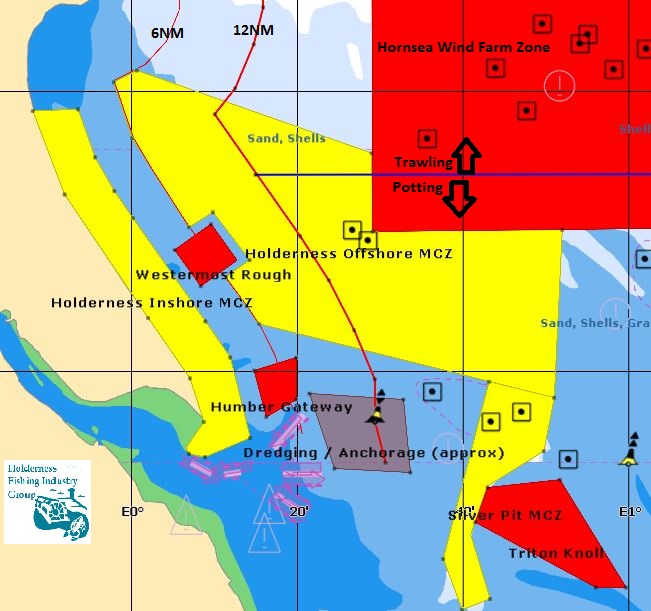
Excluding fisherfolk from areas that they have fished for generations in order to salve the consciences of middle-class, sandle-shod, cord-wearing pseudo-intellectual hippies is not the answer. Look at the chart here (provided by the Holderness Fishing Industry Group) and look at how much area could be off limits to fishermen. This area will be fished harder and unsustainably as the fishing industry is more and more squeezed. There is no evidence of any sort of spillover effect likely to occur in this region. Note how MCZs work around the requirements of the Energy Industry (new kids on the block) but not the unfashionable fish folk. Fisherfolk are likely to be the new conservation refugees and if the extremists get their way there will be further marginalisation, job losses and poverty in rural coastal towns and villages in the UK. The pretty ones will be sources of 2nd homes to the middle classes escaping from the city – packed in summer, tumbleweed and closed shops in the winter. The ugly ones will be left to rot.

Map of MCZs and Windfarms

Proposed and current fishery exclusion zones off the yorkshire coast

Although my ancestors were fishermen and whalers, I am not blindly pro-fishing and I am not anti-conservationist. I’m just anti-stupidity.

Dr Magnus Johnson is a Marine Biologist and Senior Lecturer at the University of Hull. His views are his own.