
I am an environmental marine scientist and scientific diver with a tendency to challenge anything that is too good to be true.
At the moment I teach statistical analysis and data presentation using R, fish ecology, fisheries and tropical marine ecology. I lead our Malaysia Diving Field Trip for undergraduates and act as the University Diving Officer. According to google I have published about 50 scientific works over the years on a variety of topics including the eyes of mesopelagic shrimps, marine management, decapods, artificial reefs, MPAs, krill and the mismanagement of fisheries around Chagos. My claims to fame are having had the word “Bollocks” published in nature and having been told off in the same journal for criticising international marine scientists for their lack of care over research into hydrothermal vents (something that concerns me to this day).

My real interest though is in fisheries management and over the years I have been looking at the increasing squeeze on the fishing industry by various other stakeholders and opinion holders on available space.
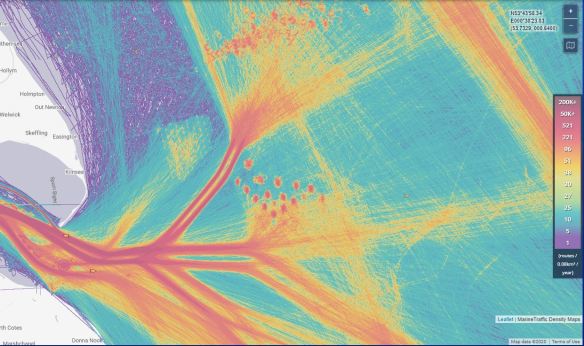
A map of shipping density around the Humber. Shipping channels, parking areas and the Humber Gateway windfarm
Current projects include interactions of offshore windfarms and fisheries, shark tagging, using, gentrification of fishing villages and developing an app to help fishermen reduce their fuel use. I’m currently supervising PhD students investigating the Ecology of the Holderness coast lobster fishery (with Sue Hull and Mike Roach), literature relating to Spurn Point (with Anna Fitzer), the history of technology in fisheries (with Martin Wilcox and Lewis Holloway) and how data can be used to understand the precarious position of some fishing village economies (with Paul Fernandes and others at Herriott-Watt University) and another looking at NetZero in relation to spatial squeeze and fisheries with Charlotte Hopkins. I have two new students starting this year to look at the economic impact of offshore windfarms on fisheries (with Anna Rita Bennato from Loughborough University) and other marine users and proximate composition of marine organisms in relation to food webs (with Sam Richardson)
For more information about my University career see www.marine-biology.org.uk
 Environmental Marine Biology
I will be issuing our next newsletter soon. I an very interested to include your piece on The most abhorrent occupation in the world, and would welcome an introduction from yourself to go with this if possible.
Hello , i am Sara Brazier and currently in my tenth year at secondary, and undergoing my GCSEs , I’ve reviewed you recent articles and have bee impressed by your work. As i aspire to become a marine biologist myself in the future, I was wondering if it was possible to send you a couple of questions for advice on how i can become closer to my target of becoming a marine biologist and maybe some day have a carer like yourself,
kind regards Sara Brazier ;
if you have the time please e-mail me : sarabraziersarabrazier @gmail.com
thank you for your time