Unknown's avatar

About Dr Magnus Johnson

Marine biologist based in the Department of Biological and Marine Sciences. Eclectic interests around fisheries, biology, ecology and taxonomy of crustaceans and statistics. Co-director of Northern Shores Marine Consultants Ltd. Member of the Scientific Diving Supervisory Committee. Advisor to Holderness Coast fishing Industry Group. Fellow of the Marine Biological Association. Course director for the MSc in Environmental Change Management and Monitoring MSc at the University of Hull. Politically left of centre. All opinions expressed on these pages are my own.

An ocean of misinformation

Summary

I wrote this in preparation for participation in the Seafood Matters podcast where I was interviewed by Jim Cowie.

The fishing industry has been subject to a barrage of simplistic propaganda over the last few years.  The non-scientific narrative funded by opinion holders has the potential to impact on governmental policy and stakeholders.  The narrow-minded obsession with MPAs as “the solution” to ecological management has the potential to do more harm than good.  Environmental NGOs and media stars with an interest in supporting sustainability need to talk to stakeholders to get balanced views.

Article

I have been troubled by the recent concerted and ideological campaign against the fishing industry in the UK by NGOs, often well funded by overseas foundations that were often set up by oily oligarchs (MarInnLeg, 2025).  In the UK what we are seeing is a fundamental industry being impacted by the cold dead hands of American philanthropists.  First Seaspiracy and then more recently the film Ocean have served as adverts for this ideological, anti-science and anti-fishing campaign.  They have been enough to scare politicians into considering blanket bans on fishing that will potentially damage an industry and vulnerable coastal communities.  The call for several months now has been to ban all trawling in Marine Protected Areas (MPAs).  This is despite the fact that MPAs have been through a consultative process involving NGOs, government and the fishing industry, are designated to protect specific features and the regulations for each one are appropriate to eliminate impact on those features.  Where the MPA is designated to protect something like slow-growing maerl beds (which serve as nursery grounds for scallops), banning bottom trawling makes sense.  Where the designation is to protect cetaceans, banning bottom trawling, that has pretty much zero interaction with cetaceans, makes absolutely no sense at all.  It is purely a vindictive attempt to target the fishing industry.

The attempts by well-funded organisations to exclude commoners from the sea that they have used to gather food for hundreds of years resembles the clearances.  The power imbalance is the same now at sea as it was historically on land.  In the past the commoner on land had no lawyers or pieces of paper to help them retain their rights.  Until recently, no one organisation (aside from the crown) could own areas of the sea inside the UK EEZ.  A fisherman’s string of pots had the same legal right to occupy an area as a jack-up barge or a windfarm.  Now windfarms take up increasing swathes of the sea and represent de facto ownership of areas of seabed.  The historic concept of freedom of the seas appears to have vanished.  We’ve seen the development of spatial management that controls when, where and what fishermen can catch, including management supported by fishermen such as real time closures (Needle and Catarino, 2011; Woods et al., 2018).  This is an effective management measure which means that when a fisherman catches too many fish of the wrong sort or size s/he reports it, and an area is closed for a while.  Now we are seeing the development of permanent marine enclosures, the deliberate exclusion of traditional users of the commons from their resources – not backed by science but by fanatical ideology.  This is a holy war by the lobbying industry against the fishing industry.  I have seen someone from Oceana present a slide at a conference that suggested respected fisheries scientists and industry representatives are “the enemy” (MBA conference, Hull University, 2025).

The law locks up the man or woman,

Who steals the goose from the common,

But leaves the greater villain loose,

Who steals the common from the goose

(17th Century song lyric)

MPAs are attractive as a silver bullet to people who are ignorant, sometimes wilfully, of the complexity of marine ecosystems.  Fish numbers increase inside areas where fishing is prevented but MPAs do nothing to reduce fishing effort (Hilborn, 2018).  In fact they increase fishing effort.  Fishing patterns are not random and have often been established over many, many years.  Fishermen target areas where there are fish.  These are often the same areas that are targeted for “protection”.  When they can no longer fish in areas where fish are abundant they have to target areas where abundance is less.  This means that they have to fish harder and cover more area and use more fuel or gear to catch fewer fish.  For example, recent work has demonstrated that spatial restrictions have doubled the carbon footprint of Norway’s mackerel fishing fleet (Scherrer et al., 2024).These naive views of the marine environment are often amplified by the voices of celebrities who have little knowledge of the complexities of marine ecology and fisheries science but, are instinctively attracted to simplistic and what appear to be blindingly obvious solutions.

For every complex problem there is a solution that is obvious, straightforward and completely wrong (Unknown)

Where large scale MPAs have been designated they have often failed to achieve any change in commercial fish numbers (Hampton et al., 2023).  This can be because the design of protected areas is influenced as much by politics as ecology (Caveen et al., 2014; Dunne et al., 2014; Caveen et al, 2015).  In addition politicians facing a barrage of slick marketing from NGOs are more likely to seek a rapid “one step” solution than engage with the complex and nuanced processes that ensure legitimate, just and sustainable transitions.

What is particularly annoying is the fact that despite the desire of some to draw pretty but often pointless boxes on charts there are actually many and varied effective methods to manage fisheries – to manage how much they catch and how they interact with the environment.  Fishermen want to save money so the trawls that they have developed in recent years in partnership with governmental and non-governmental scientists are much lighter than they were years ago and take much less bycatch – certainly nothing like the 80% figure that has been bandied about recently.  These lighter trawls skim over the surface of the seabed and require much less fuel.  Static gear nets such as drift nets once used to occasionally capture cetaceans and seals.  Legitimate fishermen don’t want to catch these animals so they started attaching pingers to the nets to scare them away.  With the global growth in the number of lobster/crab pots, possibly related to the demise of trawling, there has been a rise in some areas in the occasional cetacean entangled in the buoy lines.  Fishermen have responded to this phenomenon by working with scientists and developing ropeless fishing gear that only deploys the buoy line when the fisherman comes to collect it (Myers et al., 2019).

The ongoing dependence of the conservation industry on, or misuse of, poor science to buttress their desire to expunge the fishing industry is not new.  Many of the academic papers that have made  international headlines that suggest the fishing industry is destroying the ocean have later turned out to be untrue.  These include the assertion that all fish will be gone from the oceans by 2048 and we will have to eat jellyfish, the suggestion that trawling releases as much CO2 into the atmosphere as the aviation industry, that there are only 100 cod left in the north sea, that all large fish species have been pushed towards extinction or that fishing covers 55% of the ocean.  All have been later found to be based on really misleading analysis and are often published by scientists who have received funding from foundations that have an anti fishing agenda (Cochrane et al., 2024).  I am not aware of any core fisheries science papers that have set out to mislead the public or ended up on the Retractionwatch.com database.

Many in the conservation industry want to see little chocolate box boats skippered by Captain Birdseye types in quaint towns as the only survivors in the fishing industry.  These boats are the shop window for the fishing industry, tourists in coastal towns always gravitate to the harbour to enjoy the spectacle of fishing boats bustling around the harbour or landing their catch.  However they do not represent all of the fishing profession and are in some ways the most problematic to manage. From a carbon and management perspective the large so-called industrial fisheries that efficiently target huge shoals of pelagic fish such as mackerel are much better than small scale fishers. The fish that industrial trawlers (the combine harvesters of the sea) catch is some of the most carbon friendly foodstuff we harvest (Parker and Tyedmers, 2014).  Where small scale fishers win is in the fact that one fisherman at sea supports 7-14 people ashore, something that is completely critical for economically challenged coastal communities.

The attractiveness of fishing villages, such an important part of our culture, is such that coastal towns are being hollowed out as the price of houses in them goes far beyond what a small scale fisherman can afford (Thompson et al., 2016).  The well-heeled folk who can afford to retire to quaint coastal villages or own 2nd homes, that remain empty for months at a time, have a different set of values than the industrious folk who built these communities.  The new inhabitants value the aesthetics of the environment in which they live but have no deep economic ties to it.  They see their values as being superior to those of the “natives” who once populated these places year round and depended on what they could get from the sea to make a living.  Many areas dominated by fishing cultures are now go-to destinations for the cruise industry.  This industry burns unbelievable amounts of carbon and is turning the high streets in their target communities into Hollywood-esque facades of what they once were.  Because the cruise industry relies on large-scale corporate supply chains they don’t even buy their supplies from the communities they visit.  Their clients are shepherded ashore in packs to panic buy tat (probably manufactured in China) from touristic shops.

The holier than thou, or even racist, undertones of the conservation movement have deep roots.  The establishment of the national parks in the USA was driven by white men who viewed the indigenous populations who lived there as subhuman, filth on the face of the beautiful landscape they wanted to remain pristine, untroubled by human activity.  Our modern views of wilderness and what developing nations should look like from a global north perspective are driven by a skewed view of Africa seen by the white men who “discovered” it (Adams and McShane, 1997).  They encountered a land that had recently been ravaged by disease and war, where humanity had receded for a while.  What the white explorers saw was a ravaged landscape.  Following discovery of the continent its people were enslaved and viewed as property.  Peoples who provided slaves to work on plantations owned by northern Europeans could not possibly have the wherewithal to manage their own environments.  They needed a paternal empire to step in and give them civilization. 

When asked what he thought of Western civilization, Mahatma Gandhi replied, “I think it would be a good idea.” 

What we have seen historically on African, South American and Asian continents was driven by the same mindset that is driving current marine conservation.  Apparently fishing communities cannot possibly look after their own resources, its like letting the fox into the hen house. They apparently need people from outwith their communities to tell them how to manage the resources they have been harvesting for centuries.  There is little difference between the great white saviour in Africa or the American upper classes of the early 20th century and the entitled opinion-holders who currently seek to exclude stakeholders, who have a real and daily connection with the environment, from making a living.  Their skewed view of how the world should be is driving indigenous and semi-indigenous peoples from their traditional terrestrial and marine resources to the periphery of a modern society.  In the global south, commoners are stripped from their complex and intrinsically linked ecological and social networks to end up in poverty or serving white folks in seasonal tourist jobs or the service sector (Dowie, 2011).  In South Africa some MPAs have been unilaterally declared and what were thriving fishing villages have nice holiday homes for cape towners on the seaward side of the road and shanty towns on the landward side, full of people who used to be proud fishermen.  We see the same patterns in the global north, quaint fishing towns such as Anstruther, Staithes and Crinan have lost their reason to exist beyond being escapes from reality for wealthy city folk.

By allowing an unscientific narrative to dominate the conservation agenda in the Global North we encourage “conservation leakage”, the displacement of fishing effort to parts of the world where fisheries management is less effective.  The EU currently imports 70% of the fish it consumes (EUMOFA, 2023).  This is unsustainable and threatens the livelihoods of people in the global south who depend on local coastal, often low trophic level small pelagic species.  With climate change it is predicted that while there will be 30-70% increases in potential catch in high latitudes, there will be decreases in the tropics by 2055 (Cheung et al., 2010).  Thus socioeconomically vulnerable people will have to compete with the financial might of the global north to access their own fish that are diminishing because of the carbon heavy historical activities of the rich.

Celebrities and NGOs talk about the importance of co-management.  What they actually mean is taking the rights to make a living off commoners and giving them to corporations and populist environmentalists (Hunt and Hilborn, 2025).  The power to manage fisheries needs to be given back to the people who have an economic and social stake in their health.  Not in such a way as to make them have to constantly battle against administrators who are often relying on data that is 2 years out of date.  We need to take a deep breath, listen to the science – people like Ostrom who found that there are basic rules that make for effective commons management.  She found that although there are 7-8 general rules, every commons management system evolves organically to fit its particular context and they are very varied in their detail (Ostrom, 1990). 

Being an actor, presenter or celebrity chef and having the wealth and leisure to discus fantastical fisheries management schemes over canapes while sipping organic lime juice doesn’t mean you have any sort of understanding of the marine environment and what makes a successful and sustainable fishery.  If only these folk would accept the open invites they have had from the fishing industry they might spout less of the poison they receive from the conservation industry and present a more balanced view.

References cited.

Adams, J. S., and McShane, T. O. 1997. The Myth of Wild Africa. University of California Press, Berkerley.

Caveen, A. J., Clare Fitzsimmons, M. P., Dunn, E., Sweeting, C. J., Johnson, M. L., Bloomfield, H., Jones, E. V., et al. 2014. Diverging Strategies to Planning an Ecologically Coherent Network of MPAs in the North Sea: The Roles of Advocacy, Evidence, and Pragmatism in the Face of Uncertainty. Advances in marine biology, 69.

Caveen, A., Polounin, N., Gray, T., Stead, S.M. 2015. Controversy over MPAs- Science meets Policy. Springer.

Cheung, W., Lam, V., Sarmiento, J. L., Kearney, K., Watson, R., Zeller, D., and Pauly, D. 2010. Large-scale redistribution of maximum fisheries catch potential in the global ocean under climate change. Global change biology, 16: 24–35.

Cochrane, K. L., Butterworth, D. S., Hilborn, R., Parma, A. M., Plagányi, É. E., and Sissenwine, M. P. 2024. Errors and bias in marine conservation and fisheries literature: Their impact on policies and perceptions. Marine policy, 168: 106329. Elsevier BV.

Dowie, M. 2011. Conservation Refugees. MIT Press, London.

Dunne, R. P., Polunin, N. V. C., Sand, P. H., and Johnson, M. L. 2014. The creation of the Chagos marine protected area: a fisheries perspective(☆). Advances in marine biology, 69: 79–127.

EUMOFA. 2023. The EU market overview. https://eumofa.eu/the-eu-market (Accessed 18 June 2025).

Hampton, J., Lehodey, P., Senina, I., Nicol, S., Scutt Phillips, J., and Tiamere, K. 2023. Limited conservation efficacy of large-scale marine protected areas for Pacific skipjack and bigeye tunas. Frontiers in marine science, 9. Frontiers Media SA. http://dx.doi.org/10.3389/fmars.2022.1060943.

Hilborn, R. 2018. Are MPAs effective? ICES journal of marine science: journal du conseil, 75: 1160–1162. Oxford University Press.

Hunt, A., and Hilborn, R. 2025. Seychelles’ blue finance: A blueprint for marine conservation? Marine policy, 179: 106717. Elsevier BV.

MarInnLeg. 2025. Diagnostico de Grupos de Internes Azules. Fundacion – Centro de Innovacion de Estudios Juridicos Maritimos Y Pesqueros. 172 pp. https://marinnleg.org/wp-content/uploads/2025/06/INFORME-GIs_2025-1.pdf.

Myers, H. J., Moore, M. J., Baumgartner, M. F., Brillant, S. W., Katona, S. K., Knowlton, A. R., Morissette, L., et al. 2019. Ropeless fishing to prevent large whale entanglements: Ropeless Consortium report. Marine policy, 107: 103587. Elsevier BV.

Needle, C., and Catarino, R. 2011. Evaluating the effect of real-time closures on cod targeting. Ices Journal of Marine Science, 68: 1647–1655. academic.oup.com.

Ostrom, E. 1990. Governing the Commons: The Evolution of Institutions for Collective Action. Cambridge University Press.

Parker, R. W. R., and Tyedmers, P. H. 2014. Fuel consumption of global fishing fleets: current understanding and knowledge gaps. Fish and fisheries : 1–13.

Scherrer, K. J. N., Langbehn, T. J., Ljungström, G., Enberg, K., Hornborg, S., Dingsør, G., and Jørgensen, C. 2024. Spatial restrictions inadvertently doubled the carbon footprint of Norway’s mackerel fishing fleet. Marine Policy, 161: 106014.

Thompson, C., Johnson, T., and Hanes, S. 2016. Vulnerability of fishing communities undergoing gentrification. Journal of rural studies, 45: 165–174.

Woods, P. J., Þór Elvarsson, B., Sigurdsson, T., and Stefánsson, G. 2018. Evaluating the effectiveness of real-time closures for reducing susceptibility of small fish to capture. ICES journal of marine science: journal du conseil, 75: 298–308. Oxford University Press (OUP).
Seaspiracy

Let me lay my cards, face up on the table.  I spent my formative years in Shetland in the 1970-80’s in a fishing village where skippers were kings and life pretty much revolved around fishing, the sea, the weather and Shetland culture.  It was the experience of helping out on my father’s fishing boat that made me want to be a marine biologist – all those weird creatures that came up in the old fashioned and inefficient box dredge – starfish, sea cucumbers, algae, “scabby man’s heids” (echinoderms) and of course scallops and queenies.  In the days before GPS we used to watch out for rafts of gulls that would indicate shoals of mackerel just below the surface feeding on baitfish. Like many brought up by the sea and involved in the fishing industry, I love it.  I work with fishers and have had a few contracts around developing fisheries management plans, avoiding catching cod and helping ensure fair payment for gear displacement by offshore developments.  There are some rogues and there have been some bad practices by fishers in the past but I think that the fishing industry gets an unfairly bad press.  I often disagree with fishers but I also have a lot of time for what are an interesting, brave and entrepreneurial group of people.

The movie Seaspiracy sets out to tell the world how fishing is not sustainable, eating fish is bad for you and whale populations are declining because of plastics.  As @Taotaotasi illustrates it’s a disjointed affair with the storyline zipping from whales and plastics, whaling, tuna fishing, shark finning, ineffective institutions, coral reefs, overfishing, salmon farming, mangroves, slavery and MPAs.  It’s a mix of discussion highlighting issues that are of concern and misinterpretation of or wild exaggeration of the science.

Early in the film he highlights the importance of whales in the Carbon Dioxide cycle.  They dive deep to feed, bring the food to the surface where they defecate thus fertilizing the upper regions of the ocean where you find tiny plants (phytoplankton).  More wales = more fertilization, possibly.  Krill, along with many other pelagic animals, also take part in this regular dance from the deep to the shallows, collectively in temperate regions it is referred to as diurnal vertical migration.  According to the International Whaling commission the numbers of whales around the world look to be increasing, recovering from the decimation since the end of the 2nd world war.  The narrator makes a link between plastic debris and deaths of whales through ingestion of plastic, however according to the IWC, “clear cases of ingested marine debris causing deaths remain few and scattered”.

There is a lot of focus on people driving cetaceans ashore to butcher them in Taigi (Japan) and the Faeroe Isles.  The former has only being going on since 1969 and is said to be driven by the sale of dolphins to ocean life centres and the sale of dolphin meat.  He also claims that in Japan it’s driven by the desires of fishers to reduce competition for fish.  The Faeoese whale drive is a much older and ingrained traditional affair and the meat is eaten (there is a good documentary here that explores the issues in the fishery in Faeroe).  It’s not a particularly pleasant spectacle but the animals are quickly dispatched and the folk that eat them are the folk that kill them.  These are pilot whales which are not thought to be endangered. Ironically these animals, along with large tuna are going to be less attractive as food because they have significant amounts of mercury in them.  There are ongoing investigations relating to the health effects of consuming too much whale meat in the Faeroes.   The truth is, as he points out later, that these events are pretty minimal in the grand scheme of things – maybe a 1000 dolphins a year in Japan.  More cetaceans are killed as bycatch in other fisheries.

He states that Pacific Bluefin tuna are at 3% of their original stock levels and that they are endangered.  They are neither.  Current stock levels are 4.5% of the biomass you would expect if fishing effort was zero and it is rebuilding so that the stock has improved to vulnerable status.  Still not fantastic but it illustrates that the relatively young science of fisheries management is having a positive impact (the Western and Central Pacific Fisheries Commission was only established in 2004).  Many stocks of tuna are in relatively good condition and international management measures are improving all the time.  Satellite based monitoring systems are likely to improve management further.

He states that shark populations have dropped to 1% of their origin.  Again, this is needless exaggeration. It is true that Oceanic sharks are thought to have declined by ~70%.  For many shark populations we just don’t know, others such as the Blue shark appear to be at equilibrium or in decent condition. He suggests that 90% of large fish have disappeared.  This is just wrong. The figure is based on a paper that used catch data (which are not a good measure of population size) from a Japanese longline fishery.  He made a statement about a 99% decline in cod.  I can’t work out exactly where that came from (there have been numerous nonsensical stories about cod over the last 20 years including one about there only being 100 cod left in the North Sea) but it is patently not true, overall Atlantic cod are increasing in number. Stocks are doing poorly in the south of their range and in the Western Atlantic – this is likely to do with warming water impacting on reproduction and survival.  Shark finning gets a mention too – I find this practice abhorrent, it is wasteful.  Shark fisheries require particularly careful management due to long generation time and low reproductive rates.

He repeats the completely discredited assertion from 2006 that suggested that by 2048 there would be no fish left in the sea and we would be eating jellyfish.  The original authors of the paper no longer stand by that assertion.  It’s nonsense.  There is a suggestion that large scale extraction of fish isn’t sustainable.  This is just rubbish.  The best managed fisheries, with robust data collection, good science and observer coverage are the large scale fisheries.  These also happen to be the best fisheries when you consider CO2.  Large and efficient purse seiners use less CO2 per kg landed than those romantic wee boats that you find in rural villages.

We can’t catch fish because we don’t know where to draw the line

This made me laugh out loud.  There is uncertainty in fisheries management (along with most other aspects of life) and I’d argue we do know where to draw the line.  There are instances where we don’t get it right but these are becoming fewer.  In the face of an exponentially increasing human population, fisheries management has done pretty well to stabilize fishing effort in most fisheries.  According to the FAO, 67% of fisheries worldwide are now thought to be managed sustainably.

I agreed with much of the section on aquaculture although I think salmon farmers have got a bit better at not feeding fish to fish.  Open pen salmon farming is an awful practice and I try to avoid eating farmed salmon.  Open pen marine aquaculture is not the answer.  Wild fish are a much healthier food choice and are a renewable resource.

If people can’t eat fish they will turn to other sources of protein.  This is discussed in relation to the exploitation of seas around Africa where legal EU boats and illegal fishery pirates are overfishing stocks that local artisanal fishers depend on.  He claims that in the absence of fish people turn to bush meat and then links that to Ebola.  I’d like to see evidence linking these but it is true that if people cant eat fish they will eat other animal protein.  People will not turn vegan because they can’t access fish. If they did that would bring its own environmental concerns. I’d argue that fish are a healthier source of protein and their consumption is less damaging to the planet.  The environmental costs of many terrestrial sources of protein in terms of CO2 and Biodiversity loss are much higher than most fisheries. George Monbiot suggested that the only way to save life in the oceans is to stop eating fish. He suggests that fishing is the main issue threatening the integrity of the oceans. This is patently nonsense. The proportion of threatened fish species is the lowest of any group or animals.

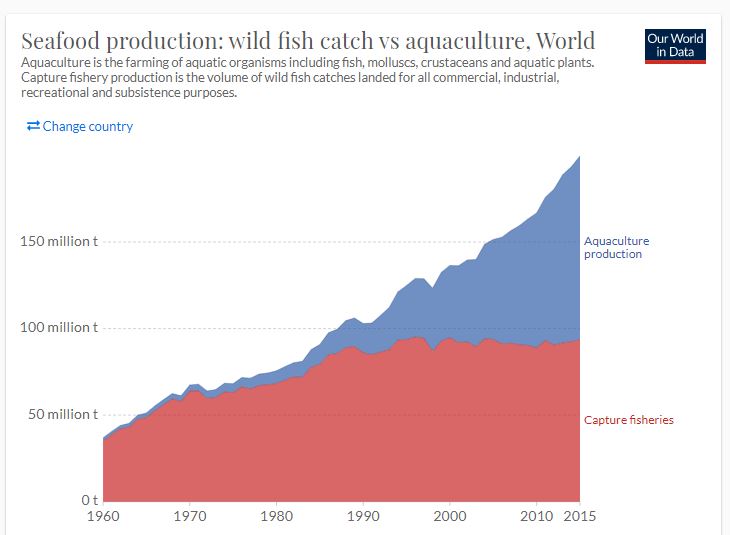
Fisheries management has generally been an overwhelming success. In the face of an exponentially growing population landings from marine stocks have plateaued. They have plateaued because of stronger fisheries management and we continue to improve. Obviously there are issues, as there are with agriculture, big pharma, transport and social inequality.

https://ourworldindata.org/seafood-production

To me the biggest problem in fisheries (well everything really) is inequality.  Rich nations develop robust management systems but still want to eat cheap fish.  They therefore import fish from countries with weaker management systems – for example Australia with its robust spatial management imports 60-70% of its fish from human consumption from Thailand, Vietnam (and New Zealand).  The rich nations export or offshore their environmental issues elsewhere – this isn’t just a problem in fisheries.

Inequality rears its most ugly head in relation to poor labour practices in some fisheries.  There are parts of the world where this is an issue and it is important to keep up pressure on government and supermarkets to end this practice.  Twenty years ago I was an observer on a longliner around South Georgia in the South Atlantic.  The Namibian crew on the boat were paid US$25 a week for a 7-day week.  The sister ship to mine sank with many crew losing their lives – the observer on that boat was a hero and wrote a book about the experience. I have been picking away at the issue since then.  It was an example of marine aprtheid where all the white officers were from the wealthy north and the black crew were from poverty backgrounds in rural Namibia. Poor labour practices mostly happen in Asia and around Africa but we also have a two tier system in the UK and Europe with some boats hiring migrant labour at 50% of the cost of local workers.  But while these are issues of concern and grab headlines, they are not in every fishery by any stretch of the imagination.

This is a disappointing documentary, it’s more about the narcissism of a privileged young white boy talking about things that anyone with a smidgeon of interest in marine conservation can tell you are problematic – Japanese whalers, shark finning, plastic pollution, open pen salmon farming, inequality, tied together with a tissue if falsehoods, exaggeration and nonsense. There is no “big reveal” here.  By breaking the law in Thailand and interviewing without a permit he may have put some poor guy at risk – someone who could very well be dead or imprisoned now.  He interviewed a social scientist who really is trying to help make changes – without informing her of the direction he was taking or what the film was for.  These are worryingly unethical behaviours and I’d be surprised if @netflix were happy with it. He picked on soft targets, folk trying to make a difference in a complex world and I think probably selectively edited the interviews to try and show the interviewees in a bad light.  This guy isn’t an environmental hero.

If you want to keep up with the real science around fisheries and people who really are trying to make a difference, I recommend bookmarking @TrevorABranch pages of all time must read and annual must read papers. In putting this article together, I’ve leaned heavily on the https://sustainablefisheries-uw.org/ library (@SustainFishUW). The site has an interesting article about how misinformation gets into the public understanding of fisheries.

If you have read this article and are concerned about the environment, it should just be a starting point. Read more, inform yourself, take nothing at face value, listen carefully to opposing viewpoints, be ready to change your mind when faced with good evidence. You won’t learn much living in an echo-chamber.

If there are any errors in this piece – please let me know, give me evidence and I’ll correct them.

If you are a twitterer see comments by @BlahaFrancisco, @Taotaotasi, @Jack_IM9, @BD_Stew, @JamesBellOcean and @SeafloorScience

Fisheries and Brexit; #brokenbrexitbritain?

In 2016, after the Brexit referendum, I was lampooned and derided for posting a tweet with #brokenbrexitbritain in it and suggesting that Brexit would be a disaster for the UK in general and the fishing industry in particular.  Despite fisheries’ totemic position in the Brexit debate and a flotilla of fishing boats sailing up the Thames, including ironically the Dutch-owned Kirkella, to advertise what a wonderful thing Brexit would be, I didn’t believe for an instant that the Conservative party would sacrifice big business finance for the minuscule (0.15% GDP; equivalent to peppa pig sales) fishing industry.  I also believed that Real Politik would rule the day – the larger partner in international negotiations invariably wins.  It turns out, I was right – Brexit is a disaster for fisheries and I’m pretty sure will be problematic across our economy. My understanding is that there was only one person in the room during negotiations with any sort of fisheries expertise but that faced with talented and well prepared EU reps, they said virtually nothing during discussions.

Pandemic admissions – levelling up

My university is a mid-ranking institution with pockets of excellence that serves a range of students (in terms of BTEC and A-level results).  Both aspire to excellence overall of course but we are not Oxbridge. I am proud of the opportunities that we give students from low participation areas and our record in launching careers for many who may be the 1st to attend a university.  You can keep your ivory towers, I’m quite happy in my slightly shabby pedagogical bungalow.

The current pandemic has not been a leveller.  Working class and BAME citizens have been the hardest hit; either directly through contracting the virus or indirectly through effects on families and support networks.  The schools that many of our applicants attend may have excellent teachers but are generally less well resourced than those in more affluent areas.  Many students will not have had the capacity to engage in any digital learning provided towards the end of their courses in response to the pandemic.  Their teachers, looking for evidence of attitude may have judged that as apathy rather than poverty. Many of our applicants have to hold down significant part-time work while studying for their BTEC or A-levels.  If your mum has just lost her job and you are fortunate enough to still have a part-time role, your income that was once destined to pay for treats, may have become essential for covering bills.

Already disadvantaged by less well-resourced schooling in deprived areas (e.g. some 6th forms do not offer science subjects as they cannot afford it), from families that may not have the time to sit around discussing science, politics or society at dinner they have a sisyphean task to get into and then through HE. People who have not experienced the kind of poverty where your mum shouts at you for cutting the cheese too thickly, where you wear your father’s far too large cast-offs or where the potatoes you grow in your council house garden are more than a middle class affectation cannot understand this.

It is not fair to reinforce these disadvantages by reacting to the pandemic by hardwiring their economic deprivation into the flawed (as all models are) statistical algorithm that estimates what their results might have been.  We have a duty to recognise the potential of our applicants and nurture it rather than judge them by our societies failures and the gross inequalities around us.  We should not be distilling someone’s potential and future opportunities down to a 2-3 digit UCAS number or summary set of grades.

Let’s not pay too much attention to attainment levels this year.  Let’s look at the journey each applicant has made and think about what they might be able to achieve and contribute to society given sufficient support.  In fact, let’s not pay too much attention to exam results in general – they are a very narrow way to assess someone’s ability on a particular day.

Spectral responses from the dorsal organ of a juvenile Rimicaris exoculata from the TAG hydrothermal vent


Magnus L. Johnson, Peter M.J. Shelton, Peter J. Herring & Sue Gardner
First published in the BRIDGE Newsletter, Autumn, 1995 and later updated.

Introduction

Previous attempts to characterise the visual capability of the dorsal organ of alvinocarid shrimps electrophysiologically have been confounded by both the damaging effects of submersible lights on the organ (see paper published after this one publication: Herring et al 1999) and the difficulty of carrying out even relatively simple electrophysiology at sea. It has been shown that, even in decapods from relatively shallow waters, light levels significantly greater than those normally experienced can result in the irreversible damage to decapod eyes (Loew, 1976; Meyer-Rochow, 1981; Nilsson & Lindstrom, 1983; Gaten, 1988). Here we report a successful attempt to record electroretinograms from a single specimen of R. exoculata.

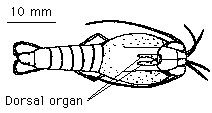
In common with many other species of abyssal crustacea (Elofsson & Hallberg, 1977; Marshall, 1979), although they possess the remnants of ommatidial structure (Van Dover et al., 1989; M. Johnson pers.obs.) the eyes of R. exoculata lack dioptrics (Figure 1). As Land (1989) points out it is likely that such ‘naked retina’ type eyes are more than adequate for the perception of digital stimuli such as may be provided by the occasional bioluminescent flash and may even provide some sort of directionality. The resolution of such eyes will not approach that of the normal spherical superposition compound eyes found in decapods (Gaten & Shelton, 1993) since each individual photoreceptor will efficiently absorb light over a 24° solid angle (Land, 1989).
Figure 1: Schematic diagram of a standard shrimp eye and the dorsal organ of R. exoculata

RIM1

In any eye, absolute sensitivity (probability of photon capture) is limited by the cross sectional area of photoreceptive pigment presented to the image (Goldsmith, 1990). In the usual spherical superposition eye, as found in pelagic and coastal shrimps, the attempt to form an image and the necessary geometry of the eye (Figure 1) limits the aperture and therefore the total cross sectional area of pigment presented. The absolute diameter of the eye is limited by obvious constraints imposed by the size of the shrimp and hydrodynamics. Within the superposition eye the thickness of the photoreceptor layer is limited by the diameter of the eye. If parallel light is to be guided to a few photoreceptors (for the purpose of image formation) the maximum outer diameter of the photoreceptive layer can be no more than around 1/2 that of the eye (Land, 1981).

In the naked retina type eye however , where all attempts at image formation have been abandoned, the constraints on the ‘aperture’ (effectively the whole eye to a perpendicular source) and area covered by the photoreceptive layer are much reduced. Van Dover et al (1989) found that R. exoculata had at least 2-7 times more visual pigment than is found in other marine crustacean eyes. If subjected to light from an antero-dorsal direction it is likely that almost the whole eye could be stimulated, rather than only a small group of photoreceptors as in species with the more usual compound eyes.

Van Dover et al. (1989) looked at the absorption spectrum of R. exoculata visual pigment and suggested that, although it peaks in the green part of the spectrum, it may have some sensitivity to far red (600-800 nm) light. Pelli & Chamberlain (1989) suggested that, theoretically, it may be possible for a shrimp with such a pigment to be responsive to small levels of 600 nm light generated as part of black body radiation given off by a hydrothermal plume. Van Dover et al (1989) assert that ‘the dominant physical features of the shrimps’ environment are plumes of water at 350°C’ and go on to suggest that these may serve as attractants to feeding areas.

The purpose of this report, and my participation in the BRAVEX ’94 cruise was to characterise the visual capability of the alvinocarid dorsal organ electrophysiologically.

Methods & Materials

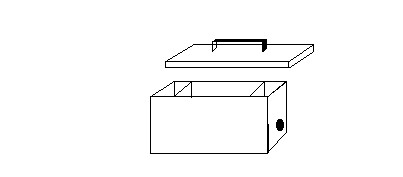
In this study an attempt was made to get round the problem of blinding by the intense submersible lights using a novel design of light-tight shrimp trap . These were 15x15x30cm aluminium ‘lunch boxes’ with an entrance and light baffle at either end (Figure 2). The inside of the box was painted matt black to reduce internal reflection and traps were baited with partially decomposed and sterilised sardines (with tomato sauce) embedded in agar. Keeping the traps light tight meant that the size of the entrance holes was limited to 50mm. The knock on effect of this was to restrict water flow through the trap, limit the dispersal of the bait scent thereby reducing the capture efficiency of the trap. Also the limitations of basket space in the submersibles, logistical, navigational and topological considerations meant that the traps were not placed in optimal positions around the vent. From 5 deployments of various duration’s (2-10 days) at TAG (26°N, MAR) and Broken Spur (29°N, MAR) only two live juvenile R. exoculata were caught using this method (Figure 3). Attempts were also made to elicit responses from animals that had been captured in more conventional ways (i.e. where no attempt had been made to protect them from excess light).

Figure 2:  Light-tight shrimp trapRIM2


The animals were transferred from the trap to chilled seawater as quickly as possible and, apart from a very brief exposure to ambient laboratory light (finding and gently handling very small prawns in the dark is almost impossible!), handled under dim red light. They were dried and securely attached by the carapace with super glue to a mount on a micro-manipulator. Preparations were held in a small chamber of cool sea water so that the gills were submerged but the dorsal organ and anterior portion of the body was kept out of the water. Electrical and high frequency mechanical interference were reduced by locating the set-up in a portable Faraday cage supported on three wheel-chair inner tubes.


Figure 3: Rimicaris exoculata showing dorsal organ

RIM3

Light was generated by a 75w xenon arc lamp (Oriel inc, Model 6000) and directed to the preparation via a quartz light guide after passing through a selected narrow pass band filter and neutral density wedge. Stimuli, at ten wavelengths, consisted of 0.1s bursts of isoquantal light (1.2 x 10²⁰ photons m-2s-1) controlled by a programmable shutter supply connected to an Ealing Electronic Shutter (Model No. 22 8411). Responses were recorded via a simple platinum electrode coated in nail varnish as far as the tip (Outdoor Girl, No. 39 [Marshmallow], Max Factor) held in a Neurolog pre-amplifier headstage (NL 102G). This was mounted on a micro-manipulator and connected to a DC coupled pre-amplifier (NL 102) and AC-DC amplifier (NL 106). A small hole was made in the carapace and only the very tip of the electrode inserted into it. Responses and stimuli were recorded on a Macintosh classic II microcomputer via a MacLab/4. Preparations were sequentially subjected to stimuli of between 360-599 nm. In addition an attempt was made to elicit a response to a hand-held tungsten lamp filtered by a 600 nm wratten gel cut-on filter ( 1.8 x 10²⁰ photons m-2s-1).

Results

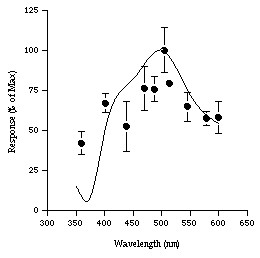
No response to light was found from any of the animals captured in conventional traps. Of the two juveniles captured in the light-tight shrimp trap, one died shortly after reaching the surface. Responses were successfully elicited from the other. The animal was tested at 10 wavelengths ranging from 350-600 nm and three experimental runs were obtained from this animal. The runs were fairly consistent each giving a response maximum at 500 nm (Figure 4). Between 350-600 nm the electrophysiological response properties of the eye are very similar to the absorption spectrum data of the visual pigment previously determined by Van Dover (1989). However when a red light from a hand held lamp was directed at the eye no response was recorded.


Figure 4 : Spectral efficiency of a juvenile R. exoculata (based on three experimental runs) compared with spectromorphometric curve of Van Dover et al .(1989)(smoothed line). Error bars are standard deviations.

RIM4

Discussion

In determining the spectral responses of a light sensitive organ, the ideal method involves obtaining a spectral sensitivity curve. This is especially true when there are several visual pigments. However, such a determination requires a V/Log I curve, preferably at each wavelength. In this case that was not possible because of the fragility of the specimen. A spectral efficiency curve which uses isoquantal flashes at each wavelength provides an alternative way of examining the spectral responses and is acceptable as long as there is a single visual pigment. This appears to be the case with R. exoculata.

The response pattern generated from a single juvenile specimen of R. exoculata appears to agree with the findings of Van Dover et al. (1989) and suggests that the dorsal organ has maximal sensitivity at around 500 nm. The lack of electrophysiological response of conventionally caught (i.e. not light protected) shrimp to light, and histological evidence (E.Gaten, pers.com.), would appear to confirm that the dorsal organ is susceptible to irreversible damage following exposure to intense lights from the submersible.

Why the animals have a peak sensitivity at around 500 nm is not clear. Aside from black body radiation, other potential sources of light include crystalloluminescence, luminescence associated with ionizing radiation, chemiluminescence, sonoluminescence and bioluminescence (LITE Workshop Participants, 1993). Many of these sources, particularly bioluminesence (Nicol, 1978), can have emission spectra congruent with the absorption spectrum of R. exoculata. The visual pigment characteristics of this species do not appear to differ markedly from those of other deep-sea species (Nicol, 1978; Frank & Case, 1988; M. Johnson, unpublished data). This is unlikely to be because of physiological or biochemical limitations, many species have evolved photopigments light of wavelengths longer than 500nm (Bowmaker, 1990; Cronin et al., 1993).

The idea that the organ may help the shrimp to locate active vents originates from suggestions that hydrothermal ‘plumes’ were at 350°C and that these could be perceived by a photopigment with a lmax of around 500 nm or more (Van Dover et al., 1989; Pelli & Chamberlain; 1989). However recent data suggest that 1 m above the vent orifice only about 2% of the plume is actually pure vent fluid, the rest is entrained sea water (R. James, pers. com.; Chin et al., 1994). Temperatures of 350°C could only be found within and in the immediate vicinity of the orifice. The shrimps don’t seem to be attracted to the actual plumes, rather they appear to congregate on the walls of active structures and in diffuse flow areas (M. Johnson, pers. obs.; Segonzac et al., 1994) where the temperature may range from 4-40°C (A. Schultz, pers. com.). It seems unlikely that a heat sensitive dorsal organ would be useful for the location of a such areas. Generally the reflective tapeta of shrimp eyes can be used to infer the likely direction from which stimuli of interest originate (Johnson et al., in prep.; Shelton et al., 1991). In the case of R. exoculata this would appear to be from above. Many other non-hydrothermal species of crustacea possess pseudosuperposition or ‘naked retina’ type eyes and generally they point in an antero-dorsal direction (Eloffson & Hallberg, 1977; Marshall, 1979; Land, 1989). It would seem most likely that the dorsal organ of R. exoculata is adapted for the perception of light dorsal to the shrimp of around 500 nm.

Physiological, behavioural and anatomical evidence suggests that many bentho-pelagic species are very sensitive to currents and chemical scent trails. It is thought that deep-sea fish and invertebrates swim across the prevailing current until they encounter a scent trail, they then swim upstream towards the source (Marshall, 1979; Gage & Tyler,1991). If fish and scavenging amphipods can locate small prey items by scent alone, how much easier would it be to locate a hydrothermal vent site?

Acknowledgements

Many thanks to Mr D. Jones for manufacturing the ‘light-tight-shrimp-traps’ at short notice. Also to the officers and crew of the Akademic Mstislav KeldyshDr E. Gaten, Rachel James, Dr C. Van Dover, Dr Cherry Walker, Dr M. Segonzac, and the BRAVEX ’94 scientific team. M.L. Johnson was supported by a NERC/CASE studentship (No. GT4/92/5/A).

References

BOWMAKER , J.K., 1990. Visual pigments of fishes. In The Visual System of Fish, Eds R.H. Douglas & M.B.A. Djamgoz, Chapman & Hall, London, pp81-107

CHIN, C. S., COALE, K. H., ELROD, V. A., JOHNSON, K. S., MASSOTH, G. J., AND BAKER, E. T., 1994. In-situ observations of dissolved iron and manganese in hydrothermal vent plumes in Juan-de-Fuca Ridge. J. Goephys. Res., 99, 4969-4984.

ELOFSSON, R., AND HALLBERG, E., 1977. Compound eyes of some deep-sea fiord mysid crustaceans. Acta zool. (Stockh.), 58, 169-177.

FRANK, T.M. & CASE, J.F., 1988. Visual spectral sensitivities of bioluminescent deep-sea crustaceans, Biol. Bull., 175, 261-273

GAGE, J. D., AND TYLER, P., 1992. Deep-sea Ecology: A Natural History of Organisms at the Deep-Sea Floor. Cambridge University Press, Cambridge, 503 pp.

GATEN, E., 1988. Light induced damage to the dioptric apparatus of Nephrops norvegicus (L.) and the quantitative assessment of the damage. Mar.Behav.Physiol., 13, 169- 183.

GATEN, E., AND SHELTON, P. M. J. S., 1993. Spatial resolution in benthic decapods, determined by electrophysiological measurement of acceptance angle. J.Physiol., 467, 371.

GOLDSMITH, T.H., 1990. Optimization, constraint, and history in the evolution of eyes. Quart. Rev. Biol., 65, 3, 281-322

HERRING, P.J, GATEN, E. & SHELTON P.M.J. (1999). Are vent shrimps blinded by science?, Nature, 398:116

LAND, M. F., 1981. Optics and vision in invertebrates. In: Autrum, H. (Editors), Handbook of sensory physiology. Springer Verlag, Berlin, Heidelberg, New York, VII/6B, pp. 471-492. LAND, M. F., 1989. The sight of deep wet heat. Nature, 337, 404.

LITE WORKSHOP PARTICIPANTS, 1993. Light in Thermal Environments, Workshop Report, Woods Hole Oceanographic Institution.

LOEW, E. R., 1976. Light and photoreceptor degeneration in the Norway Lobster, Nephrops norvegicus L. Proc.R.Soc. London. B., 193, 31-44.

MARSHALL, N. B., 1979. Developments in Deep-Sea Biology: Blandford Press, Poole, 563 pp. MEYER-ROCHOW, V. B., 1981. The eye of Orechemene sp. cf. O. rossi, an amphipod living under the Ross Ice Shelf. Proc.R.Soc. London. B., 212, 93-111.

NICOL, J.A.C., 1978. Bioluminescence and Vision, In Bioluminesence in Action, ED. P.J. Herring, Academic Press, London, pp367-398.

NILSSON, H. L., AND LINDSTROM, M., 1983. Retinal damage and sensitivity loss of a light-sensitive crustacean compound eye (Cirolana borealis). J.exp.Biol., 107, 277- 292.

PELLI, D. G., AND CHAMBERLAIN, S. C., 1989. The visibility of 350°C black body radiation by the shrimp Rimicaris exoculata and man. Nature, 337, 460-461.

SEGONZAC, M., DE SAINT LAURENT, M., AND CASANOVA, B., 1994. L’enigme du comportement trophique des crevettes Alvinocarididae des sites hydrothermaux de la dorsale medio-atlantique. Cahiers de Biol.Mar., 34, 535-571.

SHELTON, P. M. J., GATEN, E., AND HERRING, P. J., 1992. Adaptations of tapeta in the eyes of mesopelagic shrimps to match the oceanic irradiance distribution. J. Mar. Biol. Ass. U.K., 72, 77-88.

VAN DOVER, C. L., SZUTS, E. Z., CHAMBERLAIN, S. C., AND CANN, J. R., 1989. A novel eye in the ‘eyeless’ shrimp from hydrothermal vents of the mid-Atlantic ridge. Nature, 337, 458-460.


Why should I pay for your university education?

hull-uni

This question has been raised often by folk that have not gone to university.  I’m answering the question because it was put to me directly over twitter by a fisherman.

The argument goes something like “If you want to spend £52 000 on getting a degree, fine but don’t ask me to pay for it as I see no benefit”.  However, I suggest that we can’t afford not to support general attendance at university for those who are capable or want to.  In my opinion we should be facilitating easy entrance to higher or further education using a variety of modes (distance learning, summer school, traditional degrees, module by modular qualification) so that people can access education throughout their lives in order to develop skills, feed their interests or change career direction.

I’d rather people didn’t have to pay fees at all – apart from the cultural benefits of having a more educated populace, the costs of university attendance are more than recouped by the taxpayer through the generally higher incomes paid folk working in graduate jobs. My arguments for accessible university with entrance based on ability run something like:

  1. Animals become adult as soon as they become reproductively active – they have all the skills they need at that point.  That used also to be true of Homo sapiens and women would have kids as early as 16 – 18, now most women have children at nearer 30 than 20.  This is because the world has become more complex and it takes longer to beome stable and financially secure and usually both partners need or want to establish careers.  Although there are other routes, for some careers a university degree gives most people a much better chance of achieving stability.
  2. If the general population can’t get into university on the basis of intellectual ability, rather than ability to pay we will forever be governed by fatuous privileged turds like Gove, Johnson and Reese-Mogg who can afford the best education.
  3. The UK is a rich nation and will prosper by developing/nurturing high-tech industries (which require graduates).  We can’t compete with developing nations in industries that require only cheap labour (unless we import that labour or drop our general living standards significantly).  Our workforce for the most part needs to be tech savvy, able to exchange and develop complex ideas and to be able to sort fact from fiction.
  4. Most of us only spend about 1/3 of our time at work.  Why shouldn’t a bus driver be trained as a philosopher, artist or naturalist so that they can contribute to our hidden economy?  University should not just be about churning out fodder for industry it should be encouraging people to think, enriching our culture and appreciating knowledge.  We are all on the “transferable skills” bandwagon but at the core of a degree is the topic, whether it be marine biology or English which is the primary motivator for academics and students.
  5. Poorly educated people vote for extremism (left or right).  An educated population will have more centrist, sensible political leanings and be able to deal with complex concepts.  Uneducated populations vote for personalities or according to simple metrics such as skin colour, tribe etc. or fall victim to simple (and often false) messages from politicians who are more interested in the power they can gain than the people they serve.
  6. Everyone should have one chance to reach for the stars.  If you go to university and do well it can be a life changing experience and make a huge difference to your future life chances – no matter what your background.  While not perfect (e.g. look at gender balance of professors – mostly male) universities are much more meritocratic than other spheres of life.

Applying to university? Advice from an admissions tutor.

I have recently taken over as the Biology admissions tutor at my institution.  It is a role I enjoy as I get to meet lots of young people keen on saving the world and proud/worried parents keen on seeing their kids do well.  It’s a bit like being the departmental goalkeeper though – if we recruit well it is obviously because of my fantastic colleagues, if we do badly it’s obviously going to be my fault.

It’s part of my role to stand up in front of an audience of potential students and parents of potential students and “sell” our courses on behalf of my colleagues and institution.  In the past this was easy.  I was part of a small Centre based on a rural campus with 8 teaching-focussed academics and 40 to 50-ish recruits a year, embarking on programmes that I had helped to develop and knew inside-out.

hear_no_evil

(The response of some academics to the brave new world of paid-for HE and what it means for universities)

Things have changed.  Now I’m part of a large School of Environmental Sciences with a much more complex (and exciting) offering to potential students.  I have to sell something I know less well in a School that is inhabited by a full range of academics including specialist teaching fellows and research professors.

The other thing that has changed is that each of our potential “clients” is looking at spending ~£27 000 in fees plus living costs in order to get a degree.  There is, rightfully, a lot of focus on what this means for graduates.  However there is a degree of pressure generated also on academics and institutions – we are, more than ever, expected to deliver.  When most of us went to university we had grants, housing benefit and could claim dole during the holidays.  We were definately not rich, but we had enough to get by and life was pretty good.  The attitude to university was, I think, different to that of today.  It was more about education and less about getting a career.  The pressure was pretty much on the student to get what they could out of university.  In effect the state paid students to get an education in return for which it was implicit that they would contribute to society – not necessarily financially.  Today students pay us to help them get a degree in return for which we owe them a decent level of service and, whatever their level of ability, need to try to make sure that they will get a return on their investment.

In my dealings with students and parents in the last year or so, two types of comment have been common. From students “I’m paying £27 000 for my degree”.  Note that the emphasis is often on the piece of paper as much as the education.  To many students the mark they achieve has become as or more important as what they learn.  And from parents comments around “I don’t care about your research profile, I want to know that you will be fully focussed on my daughter’s education” and “How likely are they to be to get a job as a marine biologist/ecologist/zoologist/biologist”.

It is more important than ever that prospective students and their parents spend time investigating the institutions that they are considering and they base their final decision on as much information as possible.  It’s also worth remembering that, should you make the wrong decision, you can usually swap universities to do a similar course at the end of your 1st year.

Ten things prospective students should consider when visiting a university:

  1. How much contact time do you get with academics during the course?
  2. Do you meet enthusiastic academics and undergraduates on open days or just paid  postgraduates?
  3. What transferrable and subject specific skills does the programme offer you?
  4. What are living costs going to be?
  5. Is there on-campus accommodation of a decent standard?
  6. Can you see student evaluations of modules offered by the department?
  7. What support is offered for SPLD?
  8. Are most academics in the department members of the Higher Education Academy?
  9. What’s the male:female staff ratio?
  10. What scholarships are there available based on need or merit?

David Davis: Beneath the avuncular mask a putrid core.

It’s not often that I feel physically sick when I hear something on Radio 4 but tonight David Davis (minister for estranging the UK from the EU) managed to do just that. Every now and again the Tory mask slips and we see that beneath the jolly and avuncular exterior lurks a putrid maggot-infested core.

dadidavis

It was on BBC 4’s any questions and he was attempting to smear Jeremy Corbyn as a terrorist sympathiser. So here was a senior member of the warmongering right wing Conservative party that promotes the sale of arms to extraordinarily corrupt regimes in the Middle East who themselves promote terrorism accusing Corbyn of being a terrorist sympathiser. This is the party that is content to see machine guns, sniper rifles and armoured fighting vehicles sold to states such as Syria under the classification of “crowd control”

Jeremy Corbyn has repeatedly risked his reputation by talking to groups of people he doesn’t agree with in the interests of peace. He has publically stated that he would not press the button and it’s pretty clear he doesn’t support Trident – good for him. If someone does launch a nuclear attack at us we (innocent women, children, men) will be dead and I cannot for the life of me understand what would be gained by killing other innocent women, children and men in another country from where some mad despot has launched a nuclear strike. The ONLY answer is progressive nuclear disarmament.

For all his faults, and whether you like him or not, Jeremy Corbyn has been a lifelong pacifist who has sought to do good with the privilege that comes with being elected to the house of parliaments. To paraphrase the Beast of Bolsover “half of the tories are not crooks”, the rest appear to be lining their pockets by the sale of our infrastructure, water and NHS.

The Tories are trying to say that by agreeing with sentiments expressed by previous leaders of MI5 and MI6 and the foreign secretary, that involvement in overseas wars often leads to greater threats from terrorism at home, Corbyn is somehow a terrorist sympathiser.

That is, to quote another senior labour MP, “bollocks”.

Fisheries, the environment and offshore wind farms: Location, location, location.


2391702_c13c715a

The invisible industry

There is a general misconception that mare liberum (the Freedom of the Seas) applies in particular to fishers working in coastal waters. The common view is that access to the sea is homogenously distributed and all fishers can and do work anywhere and everywhere. So when a new structure or restriction is introduced to the coastal environment, people believe that fishermen can simply fish elsewhere. This view is not restricted to those that have a remote and often romantic view of the small boat rural fishing industry either. In a desk-based environmental impact assessment carried out prior to the installation of underground gas storage caverns on the Yorkshire coast the consultant remarked:

“No fishing takes place in this area, though one cannot discount some small scale exploitation” (a consultant cited in Hart & Johnson, 2005).

This observation was made in a region of the coast where there are numerous small inshore fishing boats and one of the biggest crab/lobster fisheries in Europe netting around £4 million a year for a community with few other industries. If the consultant had bothered to look carefully from just about any point along the coast he/she could have counted over 100 buoys, each attached to 20-30 creels on the sea bed. Fishing occurs everywhere along this coast. But it is transient and the degree of activity is not always immediately obvious, so it can be invisible to planners – unlike the physical structure of an oil rig or sewage outfall that can be marked on a chart.

Under-represented and misunderstood

Coastal, or inshore fishers work in a complex environment fraught with hazards, complex regulation, patchy distributions of their target species, exclusion zones and informal territories. These problems are exacerbated by the fact that the distance that an inshore fishing vessel can travel from their home port is limited by the speed, size and capacity of their vessels. The cumulative impacts of these factors on fishers are often poorly understood by those outside the industry. The regulators and proponents of coastal developments are comfortable in the be-suited, jargonistic and bureaucratic worlds of legal negotiation, planning legislation and public relations.

.
But it’s a world alien to most fishers, who as hunters earn their living by their wits, often at night and in harsh environmental conditions. They are typically highly independent individuals and naturally protective over their way of life. Unused to communicating their opinions and needs to institutions and the public, they do not always represent themselves very well in board rooms, and historically there has been no fishing equivalent of the “landed gentry” to argue their case in the upper circles of UK society. This is not an excuse to view them as “poor, backward, marginal and problematic, but as important contributors to the rural economy and potential focal points for market development in areas otherwise remote from the cash economy” (Hart & Johnson, 2005). A study of rural inshore fishers in Ireland demonstrated that one fisher at sea supports about 7 people ashore and that each fisher was worth an aggregated £34 000 per annum to the community (Meredith, 1999).

A rush to renewables

Offshore wind electricity generation is at the forefront of the UK’s drive to source 15% of energy supplies from renewables by 2020 (BERR, 2008). As renewables contributed only 1.5% to the UK’s energy demands in 2006 the scale of the task is substantial, and is leading to the designation of large areas of the sea for wind farm development. There has been a lack of precision with regard to how different stakeholders are involved in the process. The greatest challenge for developers is engaging with fishers at the local level who do not have someone in an office with the expertise, time and inclination to review the substantial documentation associated with marine development/construction projects. This is not helped by the fact that regulators such as DEFRA have generally been much more focussed on biology and economics than the most important area of science relevant to engaging and understanding stakeholders – social science (SAC Secreteriat, 2007). Early decisions on wind farm locations were made using a broad brush approach and with little stakeholder engagement. It was common in the second round of planning to see consultation only lasting 4 weeks (Gray et al, 2005). And yet location is the key issue that determines impact upon fishing communities, so these time restrictions instantly reduce the scope for useful and positive negotiations with fishers. Environmental Impact Assessments (EIAs) undertaken once the sites are allocated become inherently biased towards justifying the location. This is not helped by the fact that EIAs are carried out by consultants under contract to the developer, who in practice may lack fisheries expertise or the necessary investigative resources.

EIA

The documentation associated with a single EIA, produced by a team of administrators, consultants and scientists.  This particular EIA was delivered to a fishermen’s association office on a pallet.

.
Consequently, developers face an uphill struggle trying to convince the stakeholders with local ecological knowledge of the validity of their own reports, often based on desk-studies authored by what the fishers regard as pet scientists. Consultation meetings with fishers can often be little more than last minute box ticking exercises where frustrated and poorly informed fishers vent their fury. This allows the developer to adhere only to minimum statutory requirements, citing unreasonable behaviour on the part of fishers. In fact, fishers are sometimes viewed by developers as little more than obstacles with no real rights of tenure who can be bought off, no matter whether payment of compensation is in the interests of the community and environment or not. In contrast, developers are often viewed by fishers as arrogant, devious and well connected with the institutions and regulators responsible for control of their resource (Hart & Johnson, 2005).

Environmental arguments

In an arena increasingly peppered with constraints and tensions, the development of wind farms will unavoidably result in displacement of fishing activity in different ways depending on location. At worst, livelihoods and fishing communities are at stake if fishing opportunities are removed or additional costs are incurred to divert to alternative fishing grounds that undermine the viability of fishing businesses. Developers sometimes cite declining fish stocks and the potential conservation benefits of exclosures as additional reasons to press ahead with wind farms, whether or not the local community objects. It is easy for developers and those that support wind farms to cite claims by environmental NGOs that all fished stocks are in decline. In reality, there is a recognised lack of data at appropriate scales for inshore fisheries to fully determine impact, and to be effective, restrictions on fishing activity for conservation purposes need to be set within the context of a coherent conservation strategy. Presently there is no such integration between wind farm and conservation planning processes. The initial disturbance of an area during the construction phase and ensuing noise pollution caused by pile driving are of concern with regard to fish and marine mammal populations (Hart & Johnson, 2005). The possibility that shark species may be adversely affected by electromagnetic interference is something that scientists have also been investigating. There are, nevertheless, ways that good wind farm design could mitigate impact upon fisheries. Construction activities can be planned to avoid sensitive migratory or reproductive periods and cables can be buried or shielded to limit exposure to electromagnetic fields. In the right location and with careful design, wind farms may be able to act as artificial reefs or fish aggregation devices.

Fisher safety
A wind farm array inevitably poses an increased safety risk to mariners. Fishing among turbines may seem more practical if working a limited number of lobster pots from a small boat, when compared to towing a trawl from a larger one. But there are no hard and fast conclusions on the types of fishing activity that would be compatible from a safety point of view. Sensible safety criteria must, therefore, be agreed on a case by case basis. Outside of any safety exclusion zone that is designated, it is down to skippers to assess their exposure to risk according to the local circumstances, weather conditions and fishing method employed. Some developers prefer to automatically excluding fishers from wind farms completely on safety grounds. That is understandably not something that fishers favour! However, even when fishing activity is not possible, consideration should be given to assess whether it is safe to allow passage to access fishing grounds that would otherwise be blocked. Lessons can be learned from the interactions of the fishing and oil and gas industries. Decommissioning (or recommissioning) in particular needs to be carefully considered now rather than in 20 years time. The stakes for the environment and fishing industry are likely to be higher as the ecological and spatial footprint of wind farms is so much larger. The key issues for all concerned with wind farms, which were less significant with the oil and gas industry, are location and access, and it is these that require real stakeholder involvement and proactive decision-making which takes effective account of the sensitivities and needs of fishing communities.

Originally published: Johnson, ML & Rodmell, DP (2009). Fisheries, the environment and offshore wind farms: Location, location, location. Food Ethics, 4(1): 23-24

Magnus L Johnson (Lecturer in Environmental Marine Biology, Centre for Environmental and Marine Sciences, University of Hull)

Dale P Rodmell (Assistant Chief Executive, National Federation of Fishermen’s Organisations)

.

BERR (2008) UK Renewable Energy Strategy: Consultation Document. Department for Business, Enterprise & Regulatory Reform

Bratton S, Hinz S (2002) Ethical responses to commercial fisheries decline in the Republic of Ireland. Ethics and the Environment 7: 54-91

Gray T, Haggett C, Bell E (2005) Offshore wind farms and commercial fisheries in the UK: A study in stakeholder consultation. Ethics, Place & Environment 8: 127-140

Hart PJB, Johnson ML (2005) Who Owns the Sea? Workshop Proceedings. lulu.com, University of Hull

Meredith D (1999) The strategic importance of the fishing sector to rural communities and Ireland: a case study of the Rossaveal Region, Co. Galway. Irish Fisheries Investigations (New Series), No. 4

SAC Secreteriat (2007) Social Research in DEFRA. Department for Environment Food and Rural Affairs, SAC (07) 33

Advertisement or scientific article?

Co-authored with John Volpe, University of Victoria, Canada

The quick guide to Aquaculture by Lucas [1] recently published in the international journal Current Biology provides a decidedly positive and one-sided view where the myriad of negative impacts associated with the industry are ignored. Introduction of exotic species or genotypes [2-9], amplification and transmission of diseases [10-13] and parasites [14-18]. Indeed the very nature of industrial-scale aquaculture serves to not only accelerate and intensify these impacts [19] but generates whole new problems when mitigation is attempted [20, 21]. For instance the drug teflbenzuron targets sea lice, a crustacean farm pest, but teflbenzuron is an indiscriminate killer of all crustaceans, equally effective against crab and lobster too. Teflbenzuron levels in the few surviving crustaceans around salmon cages are high enough to trigger human health concerns [22]. The benthic environments around net pens are typically anoxic reflecting the vast biological load of faeces and uneaten feed from farms leading to bioaccumulation of mercury in few wild species left to feed on the deposits [23].

.
The commodification of farmed seafood products like salmon and shrimp have created a race to the bottom among producers. Those generating the most product for the least investment gain the market advantage in the modern aquaculture world where consumers base purchasing decisions on price alone. Therefore maximizing economies of scale and offloading costs are fundamental to remaining competitive. Thus, overlooked corollary is that environmental issues such as those above in addition to carcinogenic product [24-26], predator control, feed sustainability, and ecosystem alteration among others are the physical manifestation of “cheap” seafood – the magnitude of these issues being directly related to the scale of ever increasing production [27, 28]. Consider the proposed Marine Harvest farm that was being considered for Galway Bay (Ireland) with a capacity of 15 000 tonnes (~3 million 4-5 kg fish). The native Galway Bay salmon number in the 10s of thousands. A single significant escape event, which is all but guaranteed [29], could eliminate this native population both demographically and genetically. All this appears to matter little, as industrial aquaculture is so prosperous that it now buys the support of former critics like the WWF [30].

.
As demonstrably poor as the international salmon farming industry is, its environmental performance is superior to all other major marine finfish aquaculture products globally [27]. In other words, as bad as it is, it’s as good as it gets. As we turn from fish to tropical shrimp farms the story becomes even darker. Irresponsible development in mangrove areas have eradicated large areas of irreplaceable coastal ecosystems which act as repositories for biodiversity, resources for local indigenous populations, natural coastal defences and sovereignty of local populations [31, 32]. Absence of regulatory oversight dramatically threatens both ecological viability [33] and human health [34, 35].

.
The underlying business model of all industrial scale fish and crustacean aquaculture is to convert inexpensive inputs to higher value outputs. This means converting vast quantities of edible but low value fish such as sardines, and anchovies into much reduced volumes of salmon, shrimp, grouper and sea bass etc. – a net global loss of edible protein but big profits for producers. Profits peak when regulations (or lack thereof) facilitate maximum consumption of “natural subsidies” such as permitting factory farm waste products to be “washed away” by tides free of charge, penalty-free escape events and transmission of pathogens to wild fauna or wholesale conversion of biophysical parameters in and around the production zone. We contend that such farms should pay the state fair market value for the natural capital their operations consume. The alternative is to internalize these costs through transition to self-contained recirculating aquaculture systems (RAS) that can be placed anywhere on land greatly reducing the impact on the environment[36].

Magnus Johnson is a Senior Lecturer in Environmental Marine Biology based at the University of Hull.  His views presented here are his own, not his employers.
Slowfish9

One slide/phrase from the Slow Fish Manifesto presented at UNESCO in Bergen

1. Lucas, J. (2015). Aquaculture. Current biology : CB 25, R1064-1065.
2. Volpe, J.P., Taylor, E.B., Rimmer, D.W., and Glickman, B.W. (2000). Evidence of natural reproduction of aquaculture-escaped Atlantic salmon in a coastal British Columbia river. Conservation Biology 14, 899-903.
3. Naylor, R., Hindar, K., Fleming, I.A., Goldburg, R., Williams, S., Volpe, J., Whoriskey, F., Eagle, J., Kelso, D., and Mangel, M. (2005). Fugitive salmon: Assessing the risks of escaped fish from net-pen aquaculture. Bioscience 55, 427-437.
4. WWF (2005). On the run- Escaped farmed fish in Norwegian waters. 44.
5. Fisher, A.C., Volpe, J.P., and Fisher, J.T. (2014). Occupancy dynamics of escaped farmed Atlantic salmon in Canadian Pacific coastal salmon streams: implications for sustained invasions. Biological Invasions 16, 2137-2146.
6. Sepulveda, M., Arismendi, I., Soto, D., Jara, F., and Farias, F. (2013). Escaped farmed salmon and trout in Chile: incidence, impacts, and the need for an ecosystem view. Aquaculture Environment Interactions 4, 273-283.
7. McKindsey, C.W., Landry, T., O’Beirn, F.X., and Davies, I.N. (2007). Bivalve aquaculture and exotic species: A review of ecological considerations and management issues. Journal of Shellfish Research 26, 281-294.
8. Xiong, W., Sui, X.Y., Liang, S.H., and Chen, Y.F. (2015). Non-native freshwater fish species in China. Reviews in Fish Biology and Fisheries 25, 651-687.
9. van der Veer, G., and Nentwig, W. (2015). Environmental and economic impact assessment of alien and invasive fish species in Europe using the generic impact scoring system. Ecology of Freshwater Fish 24, 646-656.
10. Marshall, S.H., Ramirez, R., Labra, A., Carmona, M., and Munoz, C. (2014). Bona Fide Evidence for Natural Vertical Transmission of Infectious Salmon Anemia Virus in Freshwater Brood Stocks of Farmed Atlantic Salmon (Salmo salar) in Southern Chile. Journal of Virology 88, 6012-6018.
11. Peeler, E.J., Oidtmann, B.C., Midtlyng, P.J., Miossec, L., and Gozlan, R.E. (2011). Non-native aquatic animals introductions have driven disease emergence in Europe. Biological Invasions 13, 1291-1303.
12. Price, M.H.H., Morton, A., Eriksson, J.G., and Volpe, J.P. (2013). Fish Processing Facilities: New Challenge to Marine Biosecurity in Canada. J. Aquat. Anim. Health 25, 290-294.
13. Walker, P.J., and Winton, J.R. (2010). Emerging viral diseases of fish and shrimp. Veterinary Research 41, 24.
14. Krkosek, M., Lewis, M.A., and Volpe, J.P. (2005). Transmission dynamics of parasitic sea lice from farm to wild salmon. Proceedings of the Royal Society B-Biological Sciences 272, 689-696.
15. Krkosek, M., Gottesfeld, A., Proctor, B., Rolston, D., Carr-Harris, C., and Lewis, M.A. (2007). Effects of host migration, diversity and aquaculture on sea lice threats to Pacific salmon populations. Proceedings of the Royal Society B-Biological Sciences 274, 3141-3149.
16. Costello, M.J. (2009). The global economic cost of sea lice to the salmonid farming industry. Journal of Fish Diseases 32, 115-118.
17. Krkosek, M., Morton, A., Volpe, J.P., and Lewis, M.A. (2009). Sea lice and salmon population dynamics: effects of exposure time for migratory fish. Proceedings of the Royal Society B-Biological Sciences 276, 2819-2828.
18. Liu, Y.J., Sumaila, U.R., and Volpe, J.P. (2011). Potential ecological and economic impacts of sea lice from farmed salmon on wild salmon fisheries. Ecol Econ 70, 1746-1755.
19. Pulkkinen, K., Suomalainen, L.R., Read, A.F., Ebert, D., Rintamaki, P., and Valtonen, E.T. (2010). Intensive fish farming and the evolution of pathogen virulence: the case of columnaris disease in Finland. Proceedings of the Royal Society B-Biological Sciences 277, 593-600.
20. Burridge, L., Weis, J.S., Cabello, F., Pizarro, J., and Bostick, K. (2010). Chemical use in salmon aquaculture: A review of current practices and possible environmental effects. Aquaculture 306, 7-23.
21. Cabello, F.C. (2006). Heavy use of prophylactic antibiotics in aquaculture: a growing problem for human and animal health and for the environment. Environmental Microbiology 8, 1137-1144.
22. Samuelsen, O.B., Lunestad, B.T., Hannisdal, R., Bannister, R., Olsen, S., Tjensvoll, T., Farestveit, E., and Ervik, A. (2015). Distribution and persistence of the anti sea-lice drug teflubenzuron in wild fauna and sediments around a salmon farm, following a standard treatment. Science of the Total Environment 508, 115-121.
23. Kalantzi, I., Papageorgiou, N., Sevastou, K., Black, K.D., Pergantis, S.A., and Karakassis, I. (2014). Metals in benthic macrofauna and biogeochemical factors affecting their trophic transfer to wild fish around fish farm cages. Science of the Total Environment 470, 742-753.
24. Huang, X.Y., Hites, R.A., Foran, J.A., Hamilton, C., Knuth, B.A., Schwager, S.J., and Carpenter, D.O. (2006). Consumption advisories for salmon based on risk of cancer and noncancer health effects. Environmental Research 101, 263-274.
25. Foran, J.A., Carpenter, D.O., Hamilton, M.C., Knuth, B.A., and Schwager, S.J. (2005). Risk-based consumption advice for farmed Atlantic and wild Pacific salmon contaminated with dioxins and dioxin-like compounds. Environmental Health Perspectives 113, 552-556.
26. Hites, R.A., Foran, J.A., Carpenter, D.O., Hamilton, M.C., Knuth, B.A., and Schwager, S.J. (2004). Global assessment of organic contaminants in farmed salmon. Science 303, 226-229.
27. Volpe, J.P., Gee, J.L.M., Ethier, V.A., Beck, M., Wilson, A.J., and Stoner, J.M.S. (2013). Global Aquaculture Performance Index (GAPI): The First Global Environmental Assessment of Marine Fish Farming. Sustainability 5, 3976-3991.
28. Deutsch, L., Graslund, S., Folke, C., Troell, M., Huitric, M., Kautsky, N., and Lebel, L. (2007). Feeding aquaculture growth through globalization: Exploitation of marine ecosystems for fishmeal. Global Environmental Change-Human and Policy Dimensions 17, 238-249.
29. FAO (1996). Precautionary Approach to Capture Fisheries and Species Introductions. 1-60.
30. Wilfried Huismann, D.O., Ellen Wagner (2014). Pandaleaks: The Dark Side of the WWF, (Breman, Germany: Nordbook UG).
31. Primavera, J.H. (2006). Overcoming the impacts of aquaculture on the coastal zone. Ocean & Coastal Management 49, 531-545.
32. Bournazel, J., Kumara, M.P., Jayatissa, L.P., Viergever, K., Morel, V., and Huxham, M. (2015). The impacts of shrimp farming on land-use and carbon storage around Puttalam lagoon, Sri Lanka. Ocean & Coastal Management 113, 18-28.
33. Paez-Osuna, F. (2001). The environmental impact of shrimp aquaculture: a global perspective. Environmental Pollution 112, 229-231.
34. Holmstrom, K., Graslund, S., Wahlstrom, A., Poungshompoo, S., Bengtsson, B.E., and Kautsky, N. (2003). Antibiotic use in shrimp farming and implications for environmental impacts and human health. International Journal of Food Science and Technology 38, 255-266.
35. Le, T.X., Munekage, Y., and Kato, S. (2005). Antibiotic resistance in bacteria from shrimp farming in mangrove areas. Science of the Total Environment 349, 95-105.
36. Tal, Y., Schreier, H.J., Sowers, K.R., Stubblefield, J.D., Place, A.R., and Zohar, Y. (2009). Environmentally sustainable land-based marine aquaculture. Aquaculture 286, 28-35.